Reading Intervention Binder for Beginning Readers
- 168 pages
- Kindergarten, 1st, 2nd
$19.99
DownloadOr get it with All-Access: pick any 20 resources a month for $7.
New here? Your first month of All-Access is half off with code TEACHERTOK
Already bought this, or a member?
Instant download. One teacher's license: colleagues need their own copy. Each file carries a license number.
Also on Teachers Pay Teachers: see the Bright Path Sped store
About this resource
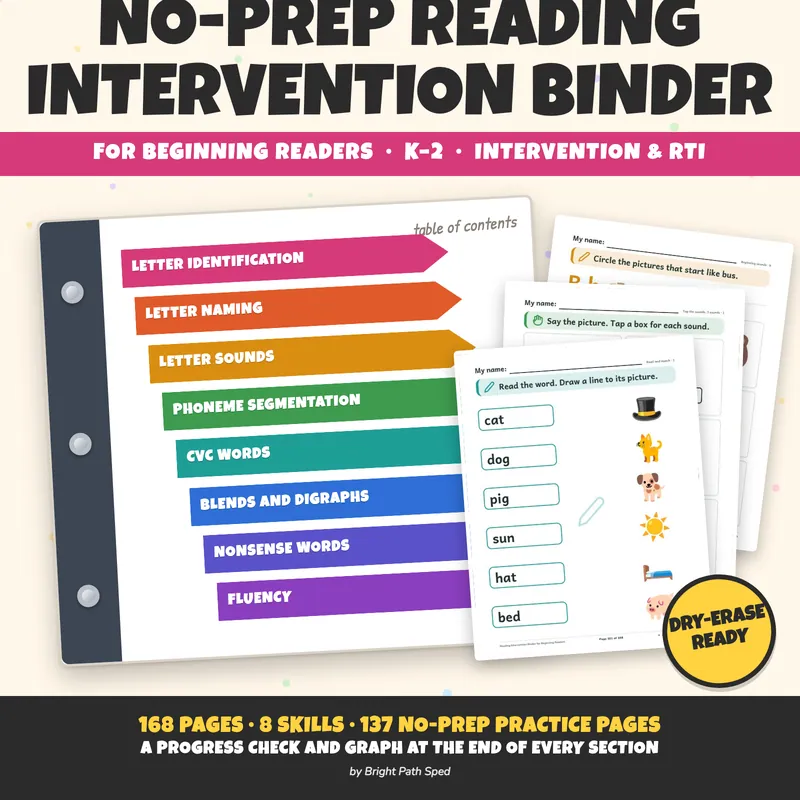
One binder for every beginning reader on your caseload. Print it once, slip the pages into sheet protectors, hand a child a dry-erase marker, and the intervention is ready: letter identification, letter naming, letter sounds, phoneme segmentation, CVC words, blends and digraphs, nonsense words and fluency, each behind its own colored tab. No cutting, no laminating, no prep beyond the sheet protectors.
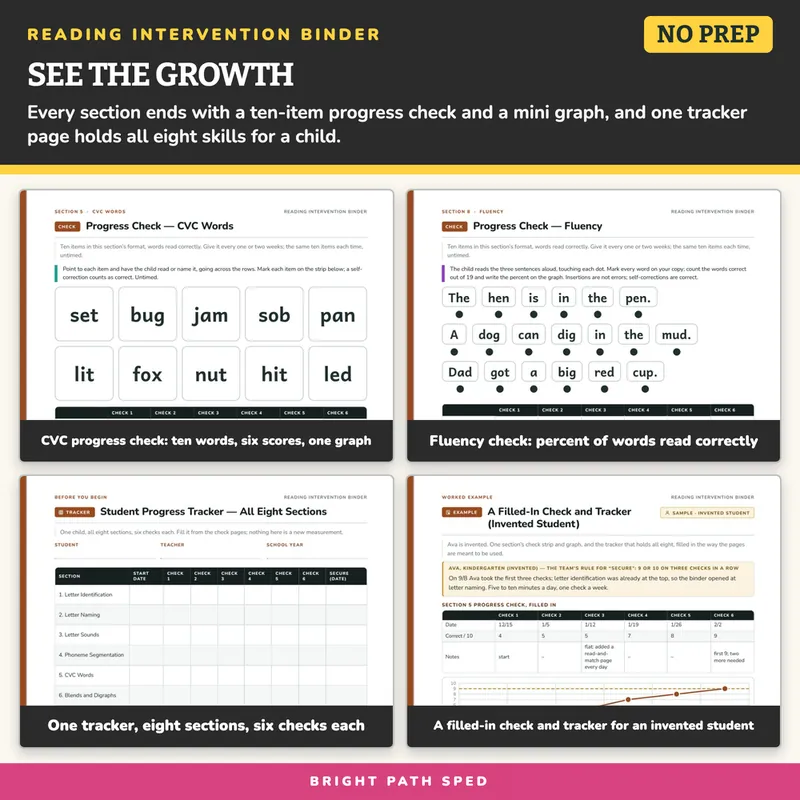
What this binder has that others do not: every section ends with a one-page progress check. Ten items in that section's own format, a six-check score strip and a mini graph on the same page, so you can see whether the practice is working without pulling a separate assessment. One tracker page at the front holds all eight sections for a child, a filled-in example shows what a month of checks looks like, and a family update page is ready to send home. Teachers come to this store for data collection; this binder is the practice and the data in one file.
The Eight Sections
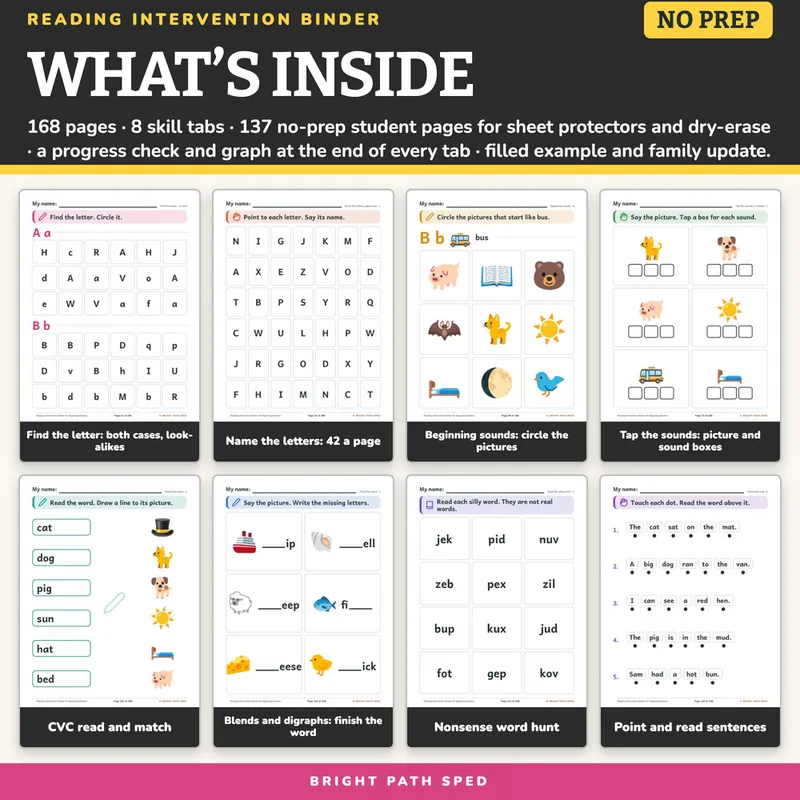
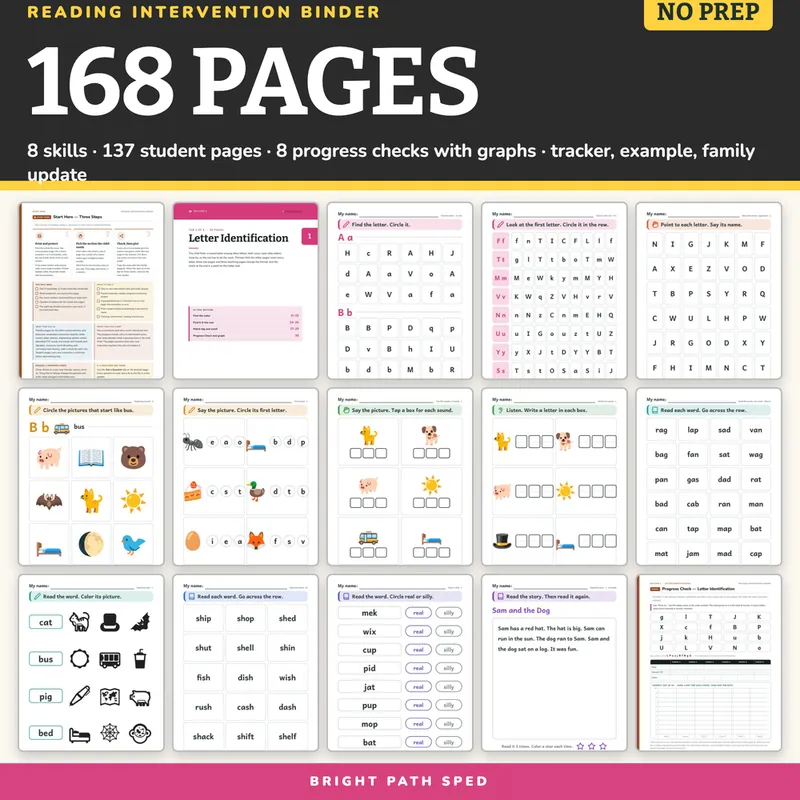
1. Letter Identification (20 pages): 13 find-the-letter pages covering all 26 letters (both cases, look-alike letters mixed in), 3 find-it-in-the-row pages, 3 match-big-and-small pages, progress check.
2. Letter Naming (19 pages): 6 uppercase grids, 6 lowercase grids, 4 mixed grids (42 letters a page), 2 name-the-row pages with a star to color, progress check.
3. Letter Sounds (20 pages): 6 say-the-sound grids, 8 beginning-sound picture pages (b, c, d, f, m, p, s, t: circle the pictures that start like the key word), 4 first-sound pages (picture, circle its first letter), the answer key, progress check.
4. Phoneme Segmentation (19 pages): 8 tap-the-sounds picture pages with three sound boxes, 2 with four sound boxes, 4 write-the-sounds pages (the teacher says the word, the child writes a letter in each box), 2 blank sound-box mats, 2 teacher word lists with every word already split into its sounds (and the write-page key), progress check.
5. CVC Words (18 pages): 5 one-vowel word grids (24 words each), 3 mixed-vowel grids, 5 read-and-match pages with pictures, 4 read-and-color pages, progress check.
6. Blends and Digraphs (19 pages): 12 word grids of 15 words (sh, ch, th, wh and ng, l-blends, r-blends, s-blends, two ending-blend pages, three mixed review pages), 5 finish-the-word picture pages, the answer key, progress check.
7. Nonsense Words (16 pages): 6 hunt pages covering all 72 nonsense words, 4 read-the-row pages, 4 real-or-silly pages, the answer key, progress check.
8. Fluency (19 pages): 6 point-and-read sentence pages (a dot under every word), 4 phrase pages, 4 sight-word grids covering the first hundred high-frequency words, 4 short decodable stories to read three times, progress check (percent of words read correctly).
How It Is Used
- One-to-one intervention and small groups: open the tab the child needs, work five to ten minutes, wipe the page.
- Practice between weekly progress monitoring probes, or as the practice behind an IEP reading goal.
- A paraprofessional or volunteer can run any page: the instruction is on it, and every picture page has an answer key.
- Print a page instead of protecting it to send home.
What This Is, And What It Is Not
This is a practice binder for the skills explicit, systematic phonics and phonemic awareness instruction teaches, with a check for each one. The pictures are clear color pictures a child can name; the read-and-color pages use black outline pictures. It is a PDF: print it, or type into the check pages and the tracker. It is not a curriculum, not a norm-referenced test, and not Google Slides or PowerPoint. The progress checks carry no benchmark score; your team decides what a passing score is for each child.
Who This Is For
Special education teachers, reading interventionists, Title I and RTI teachers, kindergarten through second grade classroom teachers with a beginning-reader group, and paraprofessionals and tutors who run the practice.
You might also need
10 Fat Turkeys Book Companion November Preschool Kindergarten 1st 2nd Special Ed
$5.00 or with All-Access
504 Accommodations Checklist Editable
$3.00 or with All-Access
504 Plan Accommodation Implementation Fidelity Data Collection Editable
$3.50 or with All-Access
504 Plan Template Accommodations Checklist Teacher Handout
$5.00 or with All-Access