Sarcasm Social Skills
- 27 pages
- 3rd, 4th, 5th, 6th, 7th, 8th
$2.00 $4.00 on Teachers Pay Teachers
Half the Teachers Pay Teachers price. The same PDF, sold direct.
DownloadOr get it with All-Access: pick any 20 resources a month for $7.
New here? Your first month of All-Access is half off with code TEACHERTOK
Already bought this, or a member?
Instant download. One teacher's license: colleagues need their own copy. Each file carries a license number.
Also on Teachers Pay Teachers: see the Bright Path Sped store
About this resource
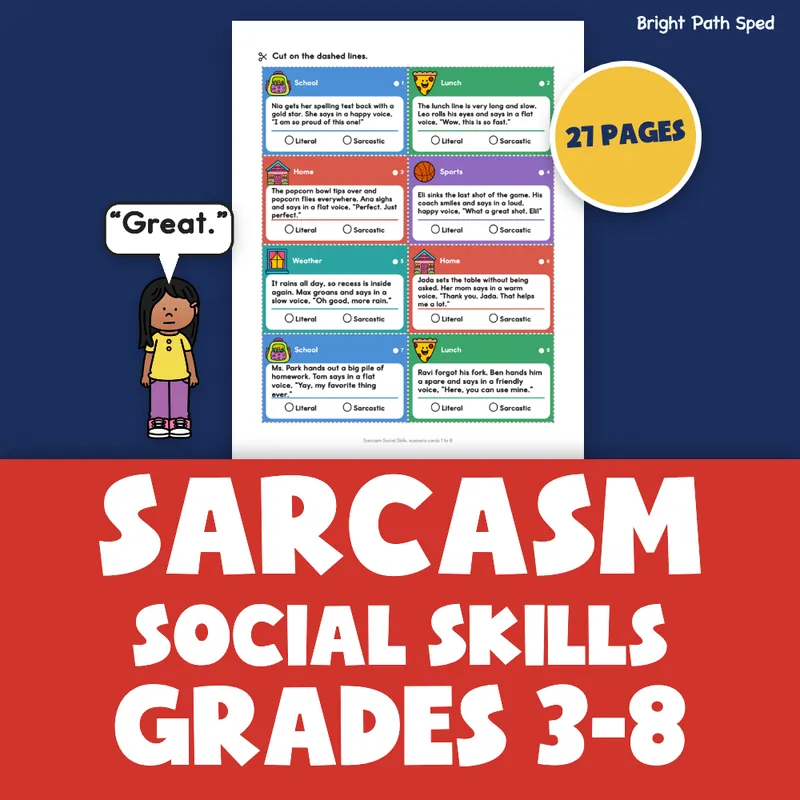
Does "Great job" mean great job, or the opposite? These Sarcasm Social Skills cards give students in grades 3-8 short, text-first scenes to read and decide: literal or sarcastic? Each card has a short scene with invented students and what one of them says. Students check four clues (the words, the voice, the face and what happened), sort the card on a mat and check the key.
What Is Included
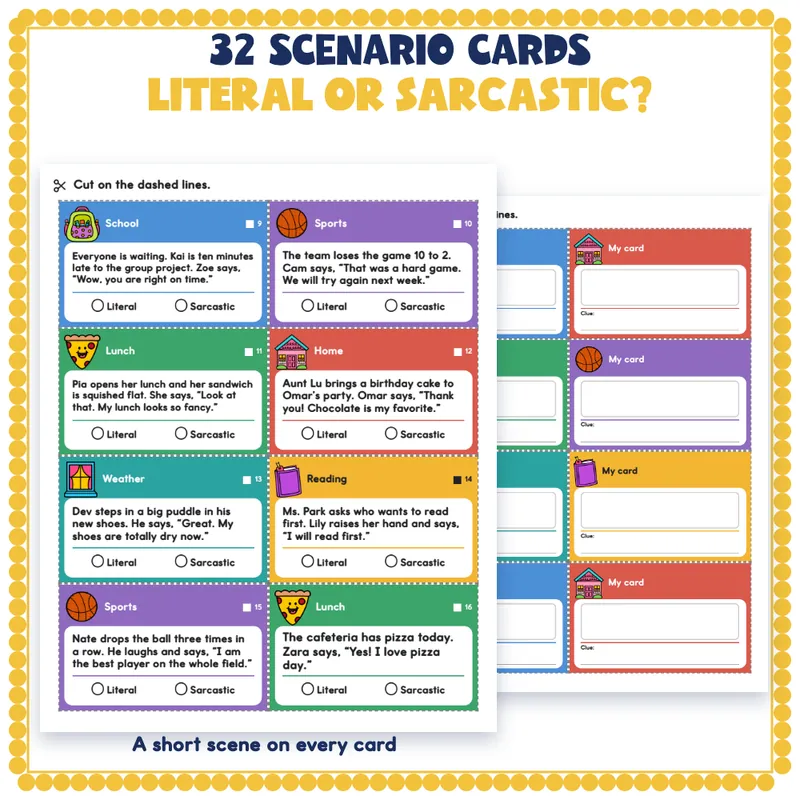
- 32 scenario cards: 16 literal and 16 sarcastic, 8 cards to a page, edge to edge for straight cuts (4 card pages)
- Three kinds of card: 8 where the voice is told on the card, 16 where the situation and the words carry it, and 8 with a subtler scene
- A sort mat with Literal, Sarcastic and Not sure yet
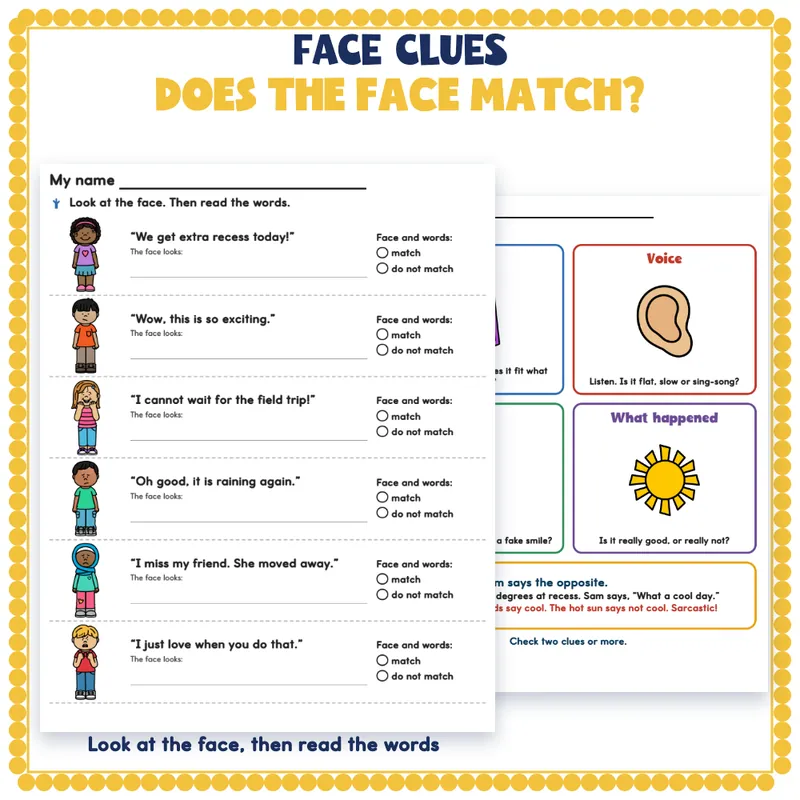
- A four-clue guide, a "say it two ways" page (6 quotes) and 2 face-clue pages with 12 faces, drawn from licensed clip art
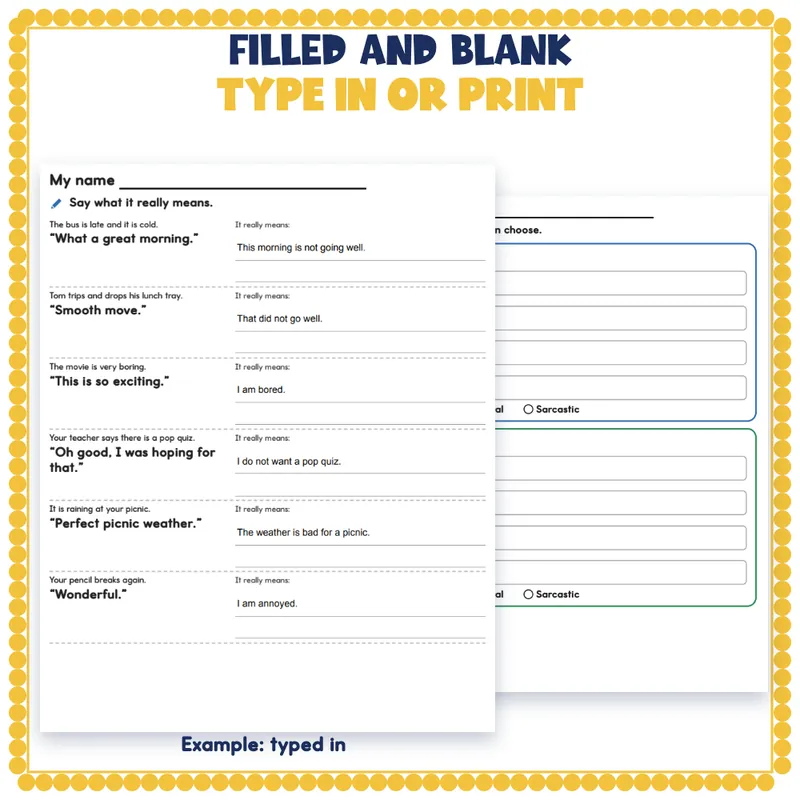
- A clue organizer (2 to a page), a "what it really means" page (6 items) and a "write it two ways" page (3 situations)
- 8 response frames for when you are not sure, with room to write your own
- 16 blank cards you type your own scene into
- A worked example with an invented student, a card-check data sheet (12 rows), a progress snapshot and an answer key (2 sheets)
- A note home for families, a Start Here page, how to use it and a What's Next page: 27 pages in all
How To Use It
1. Print the card pages on cardstock, cut on the dashed lines and laminate them to use all year. Print the sort mat and the clue guide.
2. Students read a card, check the four clues, decide, and put the card on the mat. Circle the answer on the card if you print it on paper.
3. Check the key together. For any card that was missed, ask which clue it was.
4. Write results on the data sheet, read them off on the snapshot, and send the note home.
5. To make your own cards, open the file in a PDF reader that fills forms, click a blank card, type a scene, then print.
What This Is, And What It Is Not
It is a fillable PDF with printed scenario cards, clue pages and type-in pages, and it prints on letter paper. The 32 printed cards cannot be edited; the blank cards, the clue organizer, the writing pages, the data sheet and the snapshot are the places you type. Some web browsers show the fields but do not save what you type, so use a PDF reader app and save your copy. It is classroom practice for talking about what people mean. It is not a test, a screening or a program, and nothing in it replaces what a teacher or specialist decides for a student. Every scene is about a situation, never a person's body, family or ability, and the example students are invented. It is text first: the faces are licensed clip art, not photos of real children.
Who This Is For
Special education teachers, general education teachers, paraprofessionals, counselors, speech-language pathologists, tutors and homeschool families teaching figurative language and social talk to grades 3-8. For students who need more support, use the cards that tell the voice; for students ready for more, use the subtle cards and ask for the clue that told them.