SEL Scenario Discussion Cards
- 19 pages
- Not Grade Specific
$4.00
DownloadOr get it with All-Access: pick any 20 resources a month for $7.
New here? Your first month of All-Access is half off with code TEACHERTOK
Already bought this, or a member?
Instant download. One teacher's license: colleagues need their own copy. Each file carries a license number.
Also on Teachers Pay Teachers: see the Bright Path Sped store
About this resource
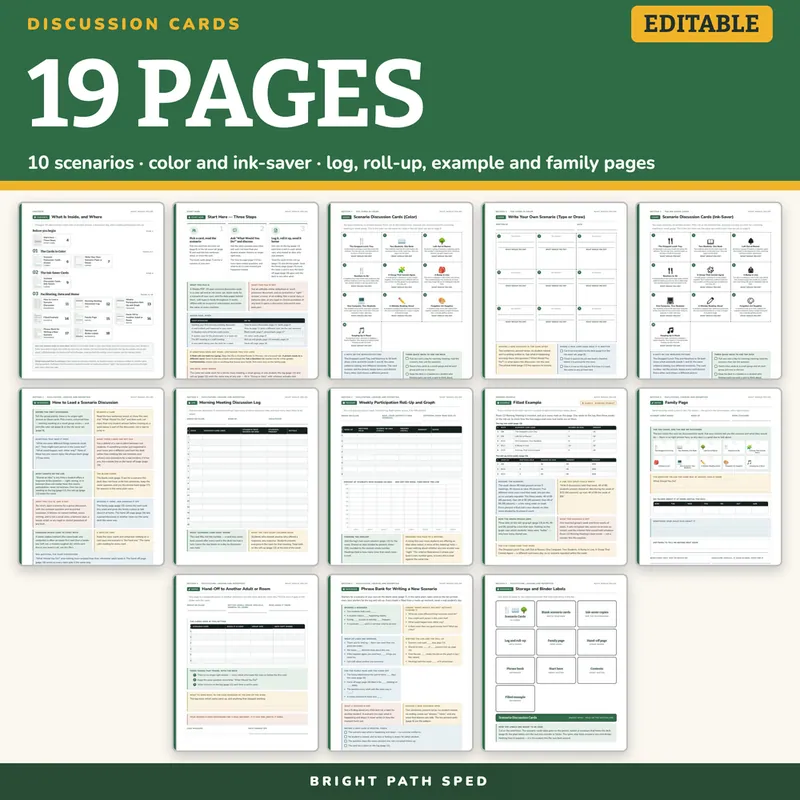
EVERYTHING INSIDE — 19 pages, 215 type-in fields
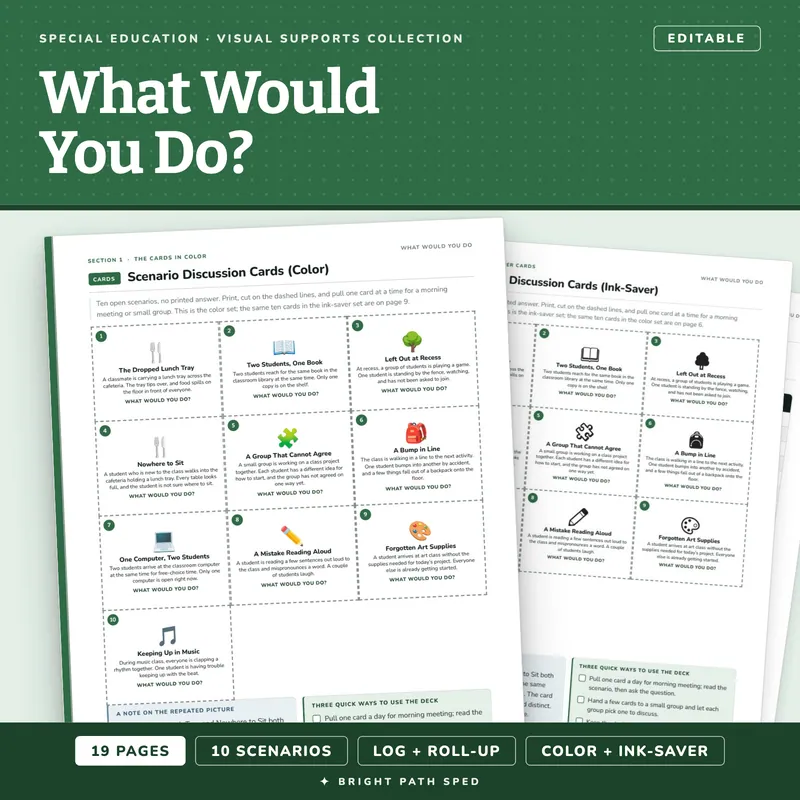
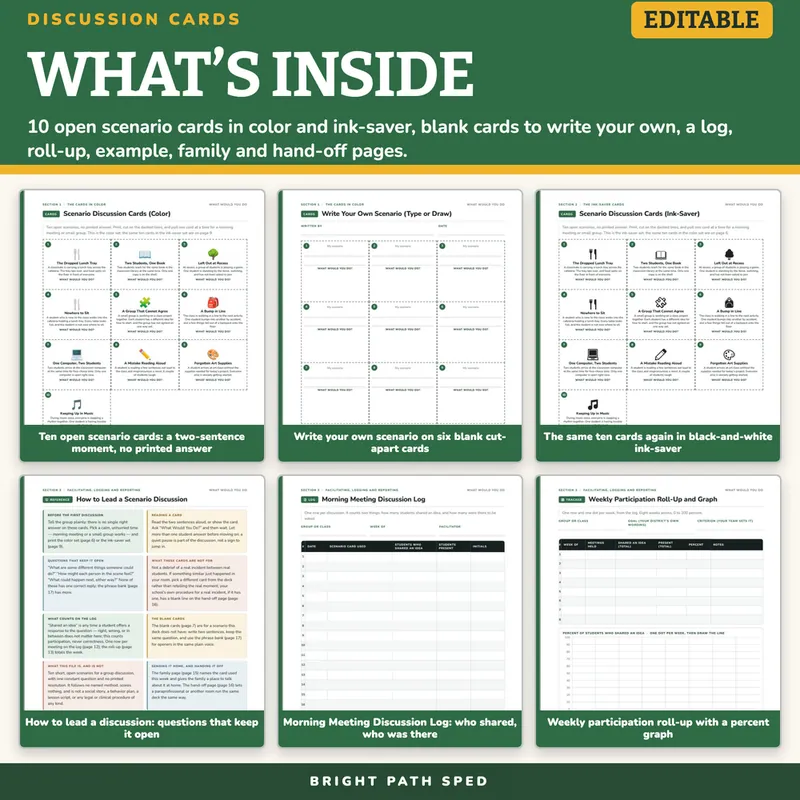
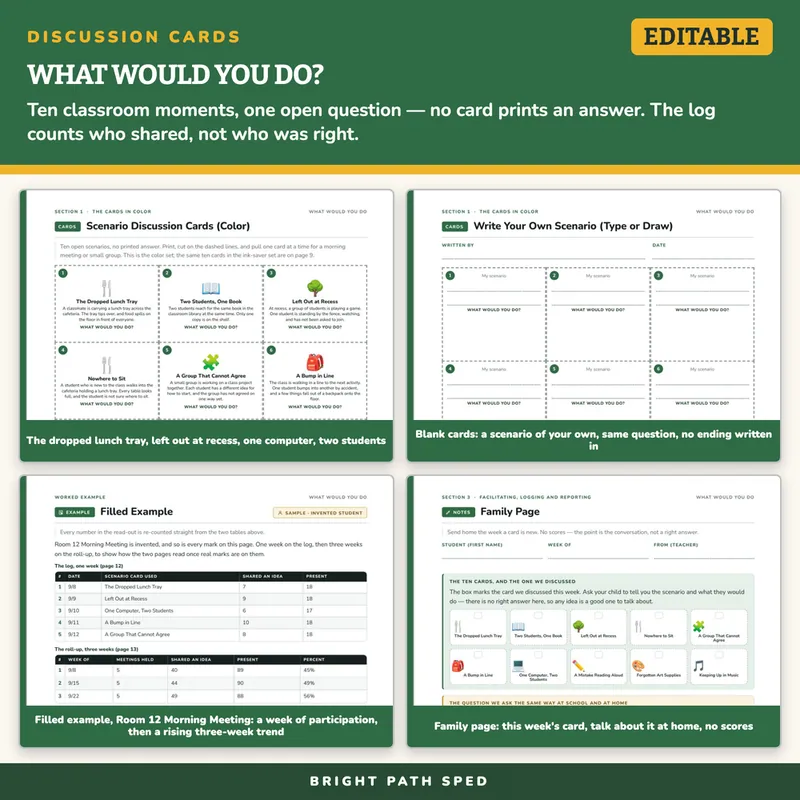
- 10 open scenario discussion cards, cut-apart, each a two-sentence everyday classroom or peer moment with no printed answer and one constant closing question, "What Would You Do?" — in full color
- The same 10 cards again in black-and-white ink-saver line art, for a photocopier or a spare set
- 6 blank cut-apart cards for writing a scenario of your own, with "My scenario" writing lines and the same constant question printed in
- A how-to page: before the first discussion, reading a card, questions that keep the discussion open, what these cards are not for (not a debrief of a real incident), what counts on the log, the blank cards, what this file is and is not, sending home and handing off, choosing which card to start with
- A Morning Meeting Discussion Log (16 rows: date, scenario card used, students who shared an idea, students present, initials)
- A weekly participation roll-up (8 weeks: meetings held, shared an idea total, present total, percent, notes) with a percent graph
- A filled example — an invented morning-meeting group, one week on the log and three weeks on the roll-up, every percent re-counted from its own row
- A family page naming the card discussed that week, a 10-card mini grid to mark it, a read-at-home table and lines for what was said at home
- A hand-off page so a paraprofessional or another room runs the same deck the same way, with a blank line for a school's own procedure for a real incident, if it has one
- A phrase bank for writing a new scenario: 20 starters in 5 groups (opening a scenario, asking the question without closing it, wrap-up lines, writing the log and roll-up, the family page and hand-off) plus a 4-point check before a new card is printed
- A storage and binder label sheet, and a spine strip
- Start Here, a contents page with page thumbnails, and a "what's next" back page
Ten everyday classroom and peer moments — a dropped lunch tray, two students who want the same book, a student left out at recess, a new student with nowhere to sit, a group that cannot agree, a bump in line, one computer two students want, a mistake read aloud that gets laughed at, forgotten art supplies, and keeping up with a beat in music — built for a morning meeting or a small group, not for a social story with an ending. No card prints a resolution, a "best" choice, or a score: the discussion is the point. A log and a weekly roll-up turn who took part into a line on a page, without ever scoring which idea was "right."
The Cards
Every card: a short, concrete everyday moment with no student named and no outcome written in, a small setting picture, and the same closing question every time. Two cards (The Dropped Lunch Tray, card 1, and Nowhere to Sit, card 4) share a cafeteria-setting picture because both moments share that setting; every other card shows a different picture. Every picture was chosen to be named in one word by a young child, in color AND in the black-and-white set.
What This Is, And What It Is Not
It is a fillable PDF: type into the blank cards, the log, the roll-up, the family page and the hand-off page, or print and use a pen. The card pages print on cardstock or plain paper; cards cut along dashed lines. It works offline with no account or subscription. It is NOT an editable online slideshow or word-processor document.
It opens a discussion with one constant question and counts who took part. It is not a social story with an ending, a behavior plan, a lesson script with a right answer, or any other legal or clinical procedure, and it scores nothing. The goal line and the criterion field on the roll-up are blanks for your district's own wording and your team's own number. "Shared an idea" on the log counts participation, not correctness, and a real incident that just happened in your room is handled by picking a different card from the deck, not by retelling the real moment — your school's own procedure for a real incident, if it has one, gets a blank line on the hand-off page.
Who This Is For
Teachers running a morning meeting or small-group discussion, special education teachers and paraprofessionals building in a regular time to talk through social moments, case managers who want that discussion to show up as participation data, and the families who get the home page sent home.
More In The Collection
Part of the Visual Supports Collection, alongside Conflict Resolution Steps Cards and Log (a six-step ordered procedure, not an open discussion), Social Stories: When Someone Is Unkind to Me (a short story with an ending) and Feelings Chart and Check-In Cards; more picture sets are being added to the collection regularly, all on the same pictures-plus-data shape.
Pictures (color pages): Noto Emoji by Google, Apache License 2.0. Pictures (ink-saver pages): Fluent Emoji, Copyright (c) Microsoft Corporation, MIT License.
You might also need
10 Fat Turkeys Book Companion November Preschool Kindergarten 1st 2nd Special Ed
$5.00 or with All-Access
504 Accommodations Checklist Editable
$3.00 or with All-Access
504 Plan Accommodation Implementation Fidelity Data Collection Editable
$3.50 or with All-Access
504 Plan Template Accommodations Checklist Teacher Handout
$5.00 or with All-Access