Sign Language Hand Signals
- 32 pages
- PreK, Kindergarten, 1st, 2nd, 3rd, 4th, 5th
$2.00 $4.00 on Teachers Pay Teachers
Half the Teachers Pay Teachers price. The same PDF, sold direct.
DownloadOr get it with All-Access: pick any 20 resources a month for $7.
New here? Your first month of All-Access is half off with code TEACHERTOK
Already bought this, or a member?
Instant download. One teacher's license: colleagues need their own copy. Each file carries a license number.
Also on Teachers Pay Teachers: see the Bright Path Sped store
About this resource
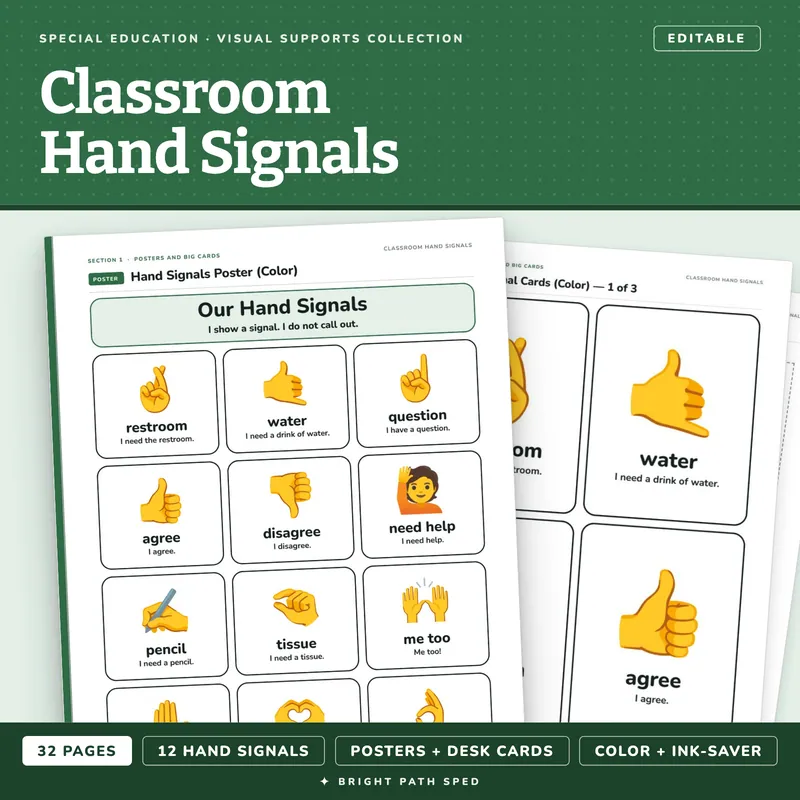
A print-and-go set of classroom hand signals for PreK to grade 5: a poster and big signal cards to hang up, practice pages where the student circles the signal they would use, and 12 desk cards to cut apart and keep. Students ask for the restroom, water, a pencil, a tissue or help with a hand signal instead of calling out. A log and a roll-up count how it goes.
EVERYTHING INSIDE — 32 pages
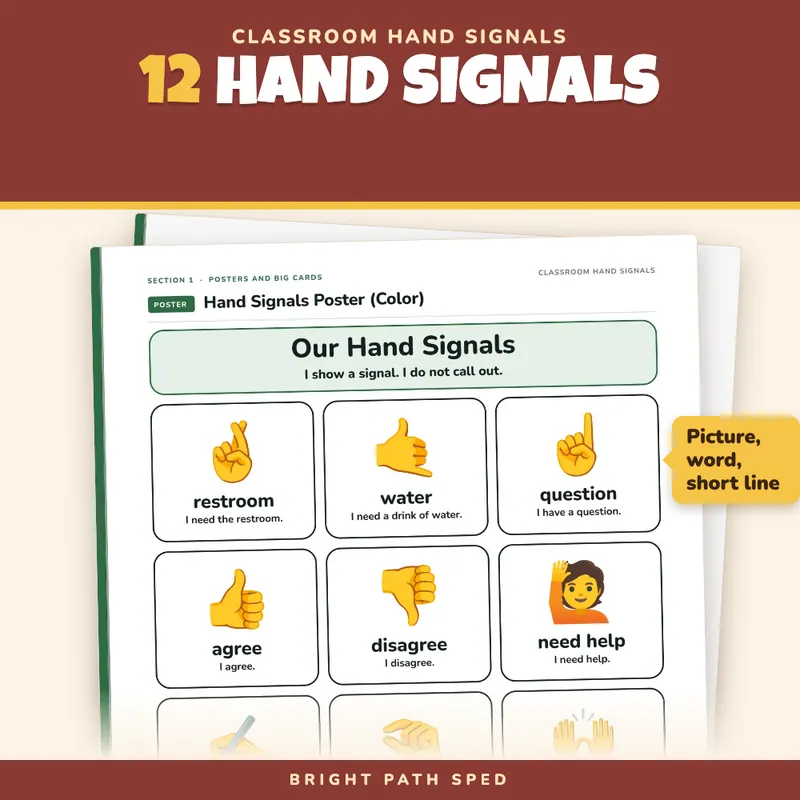
- An overview poster of 12 hand signals, each with a word and one short line, in full color and in black-and-white ink-saver (2 pages): restroom, water, question, agree, disagree, need help, pencil, tissue, me too, wait, thank you, all done
- Big signal cards, 4 to a page, in full color (3 pages) and in ink-saver (3 pages): one hand picture, one big word, one short line each
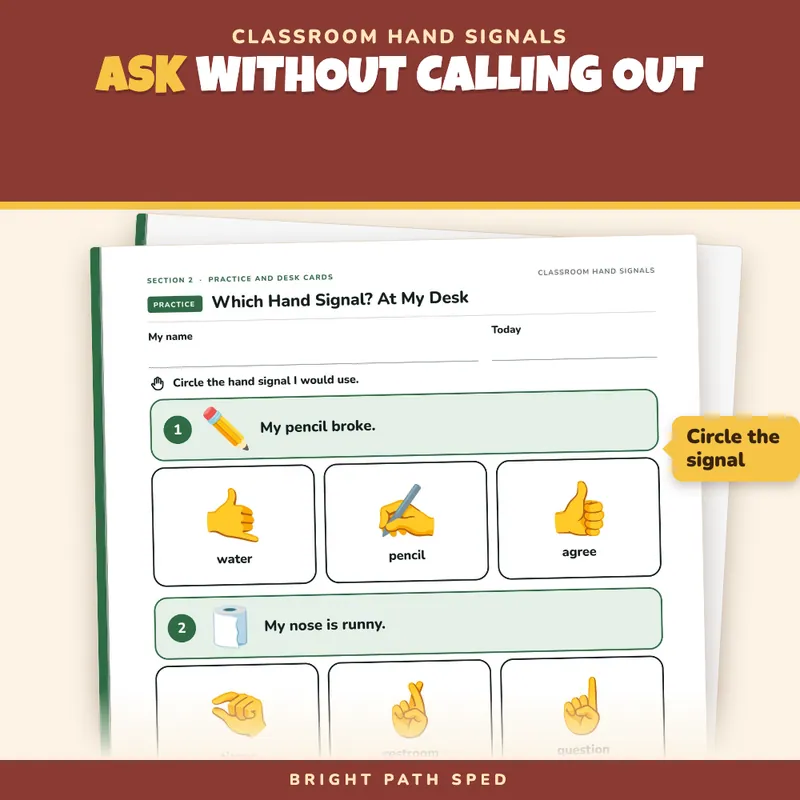
- Which Hand Signal?: 6 everyday moments, 3 pictured signals each; the student circles one (2 pages)
- Make My Own Hand Signal: a big drawing box, 3 "I use it when..." boxes and two lines to finish
- My Hand Signal Check: 15 circles (5 days, 3 times a day) for the student to color
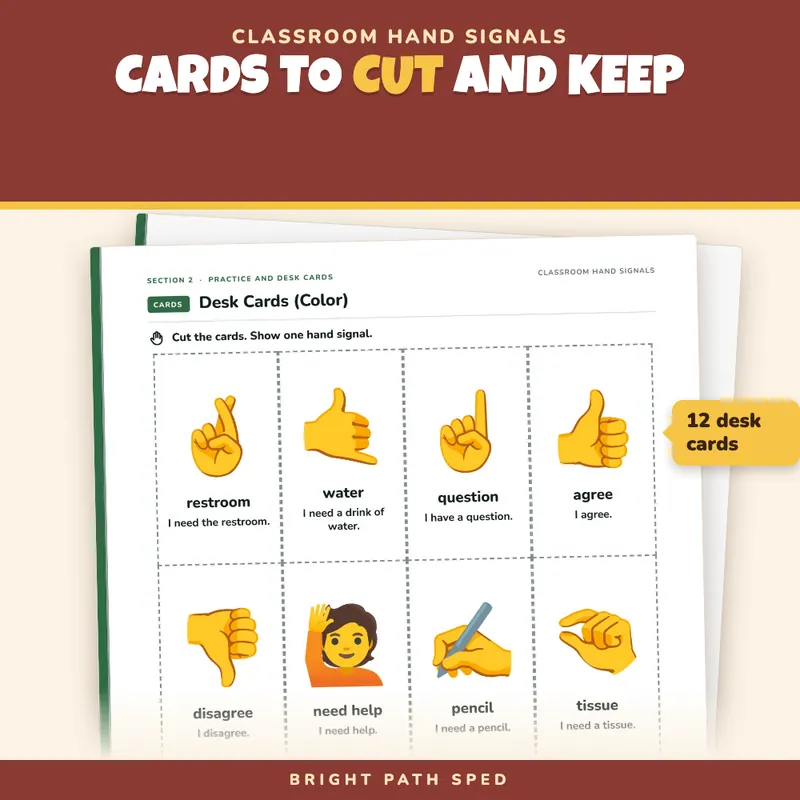
- 12 desk cards in full color, cut apart 4 across and 3 down so each cut is one straight line
- The same 12 desk cards in black-and-white ink-saver
- 8 blank cards: the student draws a hand and writes what it means on type-in lines
- A how-to page and an answer key for the 6 choice moments, with a space for your school's own rule
- A Hand Signal Log (20 rows: date, when, signal shown, showed it Y/N, initials)
- A weekly roll-up (8 weeks) with a percent graph
- A filled example: an invented student, one week on the log, three weeks on the roll-up and the signals shown across all three
- A family page with 6 small cards to cut apart and a note home
- A hand-off page so a paraprofessional or a substitute uses the same signals the same way
- A phrase bank: 23 lines in 6 groups (spoken lines for teaching and answering signals; written starters for the log, the roll-up and the note home)
- A storage and binder label sheet: 12 labels and a spine strip
- Start Here, a contents page that maps every page, and a "what's next" back page
The Student Pages
Every student page has a "My name" line, one short instruction with a picture, big hand pictures and big rounded words, and room to circle, color, draw or write. The moments are everyday classroom ones: a broken pencil, a runny nose, being thirsty, needing the restroom, being stuck on work, having a question. The student in the example is invented.
The Poster, Big Cards And Desk Cards
12 pictured signals. Hang the poster and the big cards where everyone can see them, keep a few desk cards on a desk or in a pocket, and use a blank card for any signal your class invents.
What This Is, And What It Is Not
It is a fillable PDF: type into the name lines, the log, the roll-up, the family page, the hand-off page and the blank cards, or print and use a pen. It works offline with no account or subscription. It is NOT an editable online slideshow or word-processor document.
These are classroom hand signals your class defines. They are NOT American Sign Language and the file does not teach sign language; if you want to teach a real sign language, use a real sign language course. It is not a behavior plan, a program or a clinical procedure, and it promises no outcome. What each signal means, which signals a child uses, and the number that counts as enough are blanks for your team and your district's own wording.
Who This Is For
Teachers, special education teachers, counselors, paraprofessionals and substitutes who want a quiet, shared way for students to ask for what they need, for PreK to grade 5, and the families who get the home page.
More In The Collection
This set is in the Visual Supports Collection, alongside Classroom Attention and Listening Cue Cards, Active Listening Picture Cards and Practice Sequence, Self Control Worksheets and Waiting: My Turn to Talk. Free to try first: Visual Supports Starter Set FREE.
Pictures (color pages): Noto Emoji by Google, Apache License 2.0. Pictures (ink-saver pages): Fluent Emoji, Copyright (c) Microsoft Corporation, MIT License.