SLP Language Sample & MLU Data Sheet
- 19 pages
- Not Grade Specific
$3.50
DownloadOr get it with All-Access: pick any 20 resources a month for $7.
New here? Your first month of All-Access is half off with code TEACHERTOK
Already bought this, or a member?
Instant download. One teacher's license: colleagues need their own copy. Each file carries a license number.
Also on Teachers Pay Teachers: see the Bright Path Sped store
About this resource
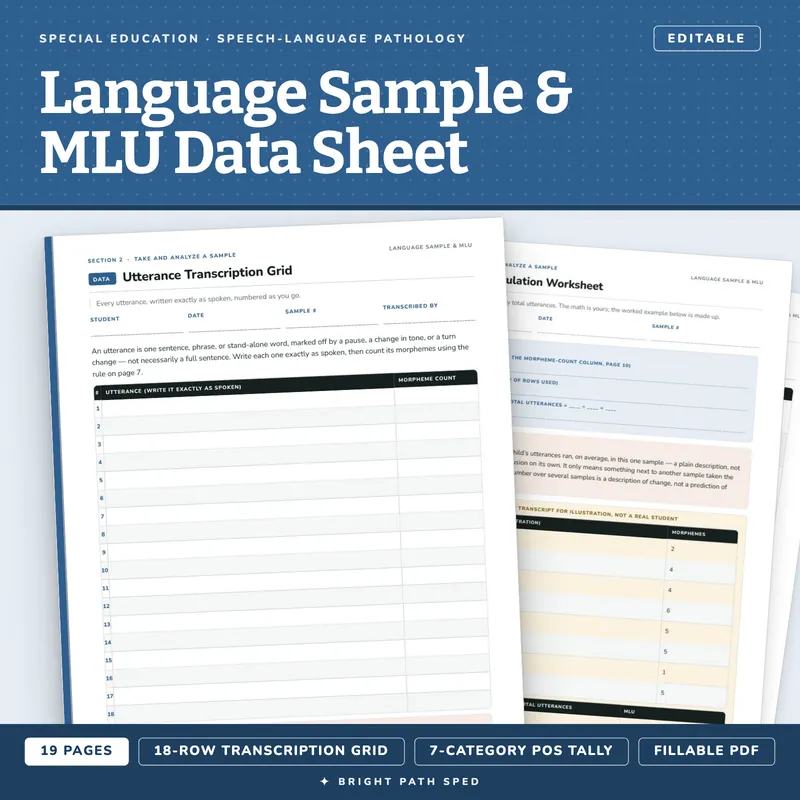
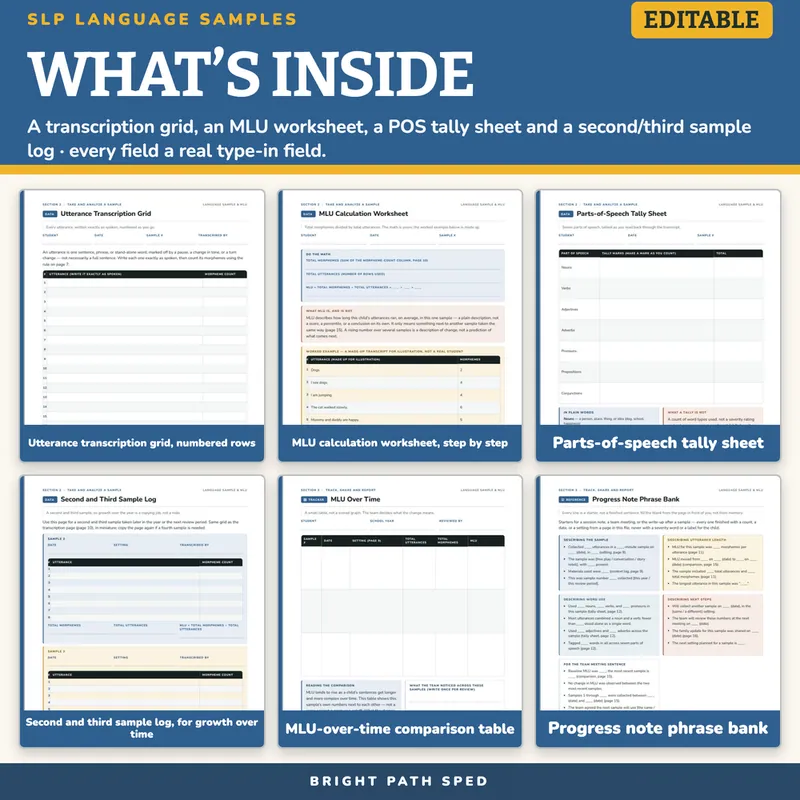
A spontaneous language sample, start to finish, in one fillable PDF: a plain-language page on what a language sample is and why a team collects one, a page where your own team writes down its own morpheme-counting rule (conventions vary by training and by district — this file never decides that for you), a session context log, an 18-row utterance transcription grid, a step-by-step MLU (Mean Length of Utterance) calculation worksheet with a fully worked made-up example, a seven-category parts-of-speech tally sheet, a second and third sample log so growth over the year is a copying job, an MLU-over-time comparison table, a family update, a progress-note phrase bank, and a worked example with every number checked. Agree on the counting rule once, transcribe the sample, do the math by hand, and copy the numbers forward.
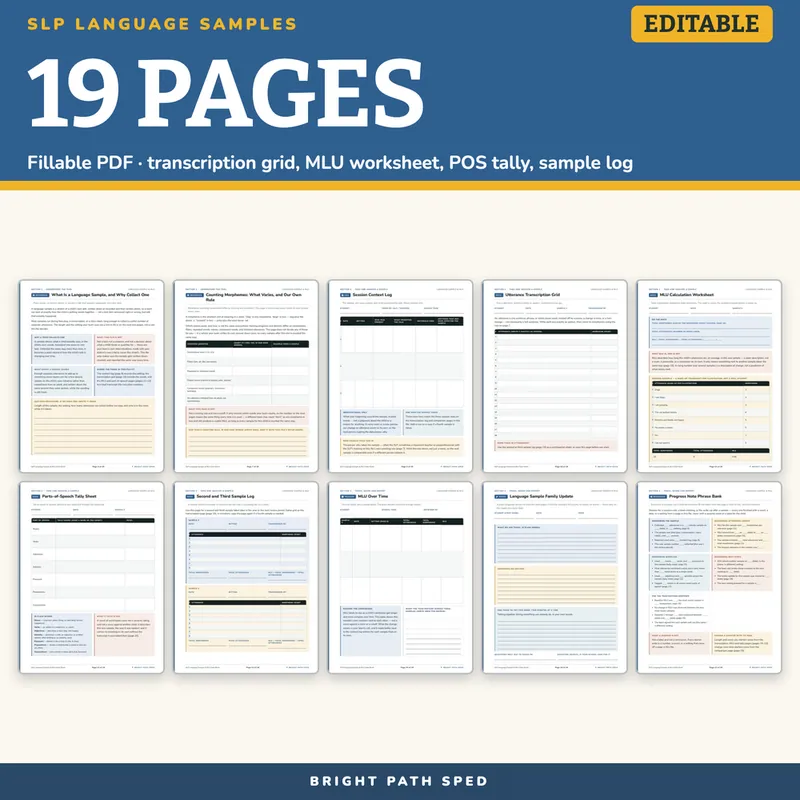
WHAT IS INCLUDED - 19 pages
Understand The Tool
- What Is a Language Sample, and Why Collect One - plain words, no clinical claims, plus a blank line for your own sample-length and setting procedure
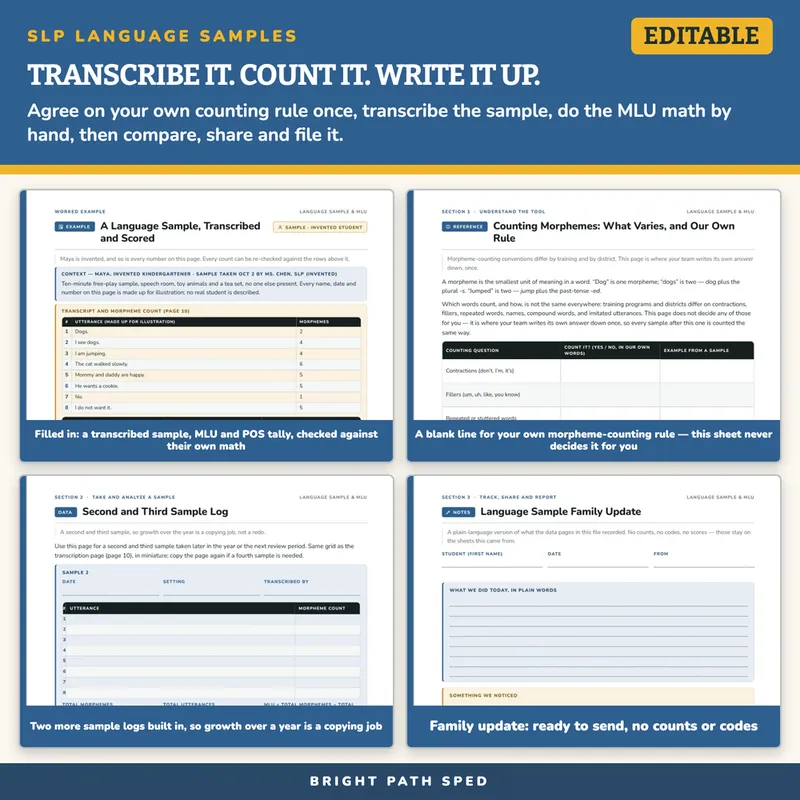
- Counting Morphemes: What Varies, and Our Own Rule - a 6-row reference table of what commonly varies in morpheme counting (contractions, fillers, repeated words, proper nouns, compound words, imitated utterances) and a blank line for your team's own rule, written once
Take And Analyze A Sample
- Session Context Log - 3 rows: date, setting, who was present, what prompted the talk, materials used, anything that may have affected the sample
- Utterance Transcription Grid - 18 numbered rows to write each utterance exactly as spoken, with a morpheme-count column
- MLU Calculation Worksheet - total morphemes divided by total utterances, step by step, plus a fully worked made-up 8-utterance example (32 morphemes over 8 utterances = an MLU of 4.00)
- Parts-of-Speech Tally Sheet - 7 categories (nouns, verbs, adjectives, adverbs, pronouns, prepositions, conjunctions), each with a plain-word definition and a tally column
- Second and Third Sample Log - two more 8-row transcription-and-math grids, so a second and third sample later in the year use the same page
Track, Share And Report
- MLU Over Time - a 3-row comparison table (sample #, date, setting, totals, MLU), not a scored graph
- Language Sample Family Update - what we did today, something noticed, one thing to try at home — no counts or codes
- Progress Note Phrase Bank - 20 starters across 5 groups (describing the sample, utterance length, word use, next steps, and the team-meeting sentence), every one ending in a blank for a number, a count, or a date
- A filled-in example for an invented kindergartener: an 8-utterance transcript with every morpheme counted (32 morphemes, 8 utterances, MLU 4.00) and a parts-of-speech tally (24 tagged words), both re-countable from the rows above them
What This Is, And What It Is Not
It is a fillable PDF. Open it in a PDF reader, click a line or a box, type, press Tab to move on, and Save As once per sample. It works offline with no account or subscription. It is NOT a Google Sheets file, a Google Doc or an Excel workbook, and it does not calculate the MLU for you — the division is done by hand, the way the worked example shows.
It is not a test, not a screener, and not a decision about what a child needs or qualifies for — those are your team's own determinations, made under your own district's criteria, never this sheet's. Morpheme-counting conventions differ by training program and by district; this file records the sample and does the arithmetic the sample produces, but the counting rule itself is a blank line your team fills in once, in its own words.
Who This Is For
School-based SLPs and case managers taking a spontaneous language sample for a present-levels write-up, a progress report, or a team meeting; anyone who wants an MLU worksheet that shows the division step by step instead of a spreadsheet that hides it; and anyone collecting more than one sample over a year who wants the second and third sample on the same page shape as the first.