Social Story Asking for Help
- 29 pages
- Not Grade Specific
$3.00
DownloadOr get it with All-Access: pick any 20 resources a month for $7.
New here? Your first month of All-Access is half off with code TEACHERTOK
Already bought this, or a member?
Instant download. One teacher's license: colleagues need their own copy. Each file carries a license number.
Also on Teachers Pay Teachers: see the Bright Path Sped store
About this resource
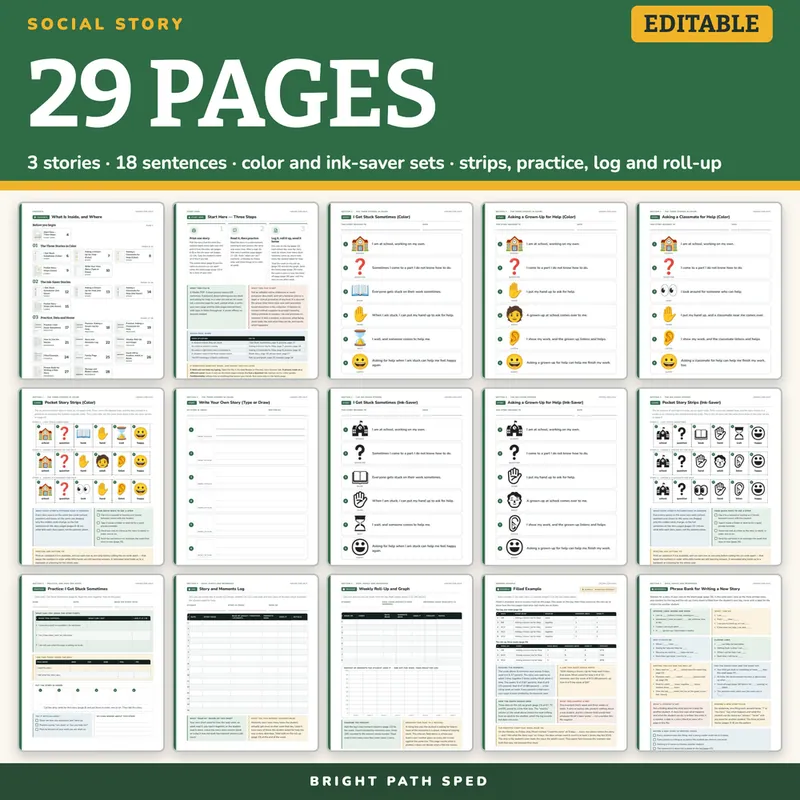
EVERYTHING INSIDE — 29 pages
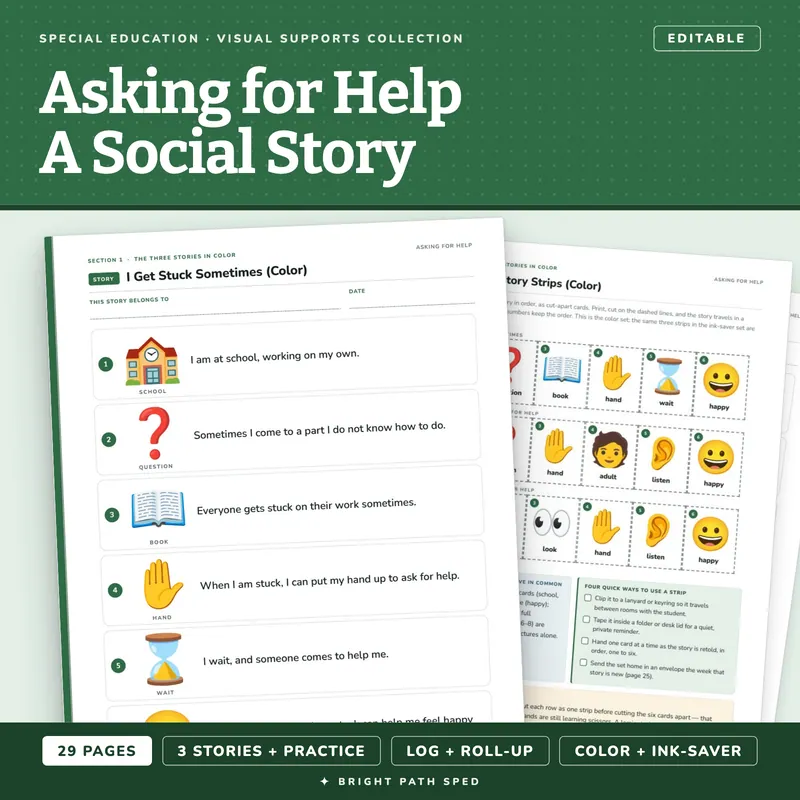
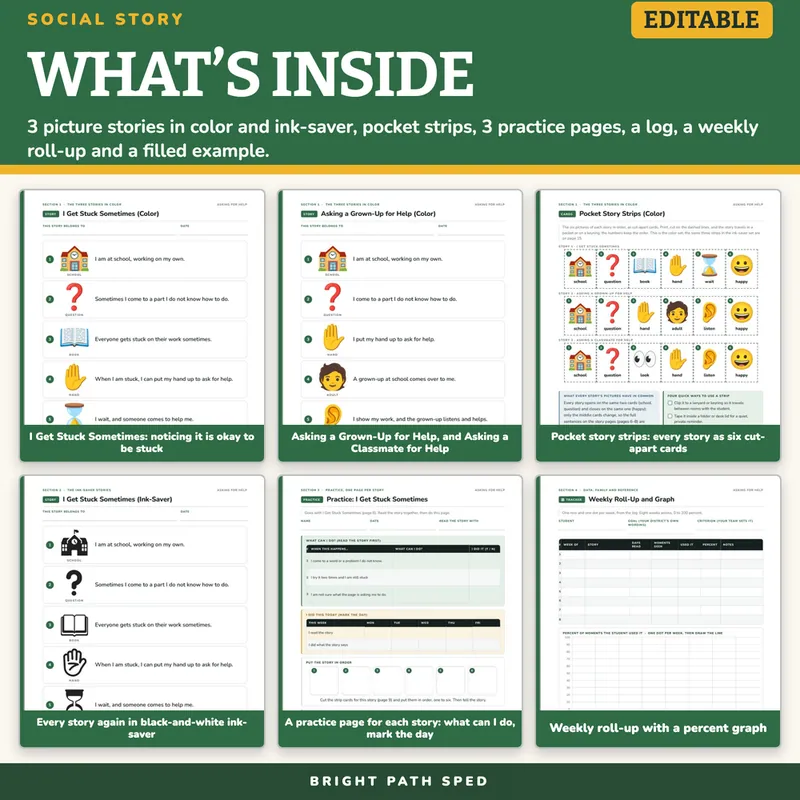
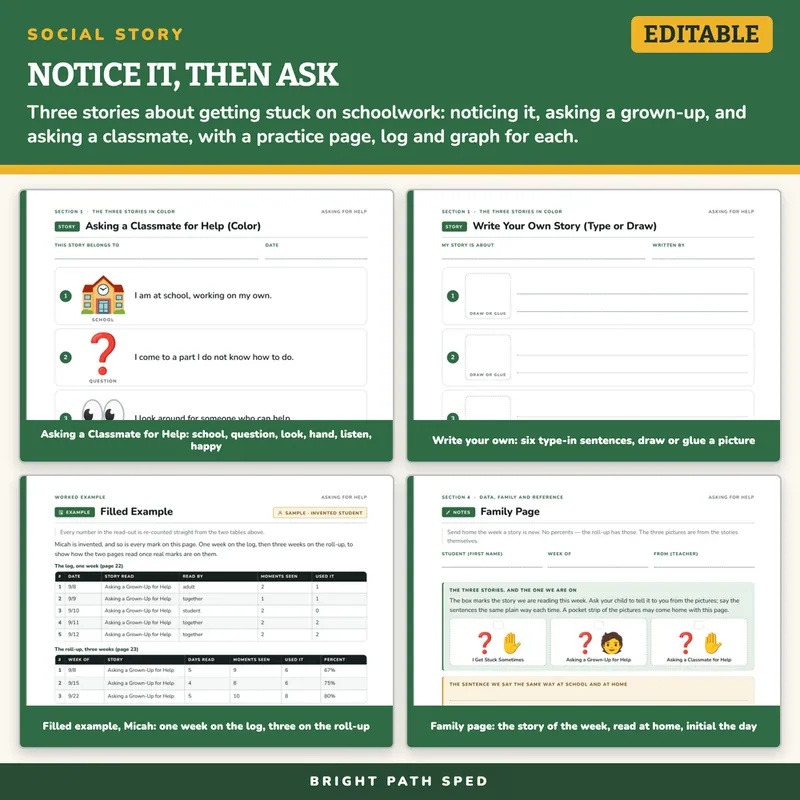
- 3 short social stories about getting stuck on schoolwork and asking for help: I Get Stuck Sometimes; Asking a Grown-Up for Help; Asking a Classmate for Help — 6 plain, present-tense sentences each (18 in all), with a picture beside every sentence and a type-in name line
- Every story twice: a full-color set and a black-and-white ink-saver set for the photocopier
- Pocket story strips: each story's 6 pictures as numbered cut-apart cards (18 cards per set, in color and in ink-saver), for a pocket, a keyring or a desk, plus a "four quick ways to use a strip" card and a printing/cutting tip card
- A write-your-own story page: 6 numbered panels, each with a draw-or-glue picture box and two type-in sentence lines
- 3 practice pages, one per story: three "what can I do?" moments from that story with a type-in answer and a Y/N box, a Monday-to-Friday "I read the story / I did what the story says" strip, six put-the-story-in-order slots for the strip cards, three things to try with an adult, and lines for the student's own words
- A how-to page: before the first read, reading a story the same way every time, which story first, the practice pages, what counts on the log, the strips and the blank page, what the stories are and are not, sending home and handing off
- A Story and Moments Log (16 rows: date, story read, read by, moments seen, used it, initials)
- A weekly roll-up (8 weeks: story, days read, moments seen, used it, percent, notes) with a percent-of-moments graph
- A filled example — an invented student, one week on the log and three weeks on the roll-up, every percent re-counted from its own row
- A family page naming the story of the week, with the three stories' pictures, a read-at-home table and lines for what happened at home
- A hand-off page so a paraprofessional, a coach or another classroom reads the same story the same way, with a blank line for a team's own order for who to ask first, if there is one
- A phrase bank for writing a new story: 24 starters in 6 groups (opening lines, what I can do, why it helps me, closing lines, writing the log and roll-up, the family page and hand-off) plus a 4-point check before a new story is printed
- A storage and binder label sheet: 11 labels (one per story, with its pictures, plus 8 plain section labels) and a spine strip
- Start Here, a contents page with page thumbnails, and a "what's next" back page
The Stories
- I Get Stuck Sometimes — school, question, book, hand, wait, happy
- Asking a Grown-Up for Help — school, question, hand, adult, listen, happy
- Asking a Classmate for Help — school, question, look, hand, listen, happy
Six sentences each, one thing per sentence, in the first person and the present tense: the moment (coming to a part of the work the student does not know how to do), who is near to ask, and one concrete thing the student can do about it. The same picture means the same word in every story, and 9 pictures cover all 18 sentences. Every picture is a concrete object a young child can name in one word — a question mark, an open book, a raised hand, an adult figure, an ear, a pair of eyes — never a drawn face standing in for a feeling like "confused" or "frustrated."
What This Is, And What It Is Not
It tells a student, in pictures, what being stuck looks like and what they can do, and counts what happened. It is not a behavior plan or any other legal or clinical procedure, and it promises no outcome. It carries no prompt hierarchy, fading schedule or mastery rule; which story a student reads first, for how many days, and when the next one starts are your team's decisions. The goal line and the criterion field are blanks for your district's own wording and your team's own number. The log counts two things: whether the story was read, and in how many of the day's stuck moments the student asked for help.
Who This Is For
Special education teachers and paraprofessionals who read a short story with a student before independent work starts, general education teachers who need one for a whole class, case managers who need that reading to show up as data, and the families who get the home page sent home.
More In The Collection
Part of the Visual Supports Collection, alongside Social Stories for Classroom Expectations, Social Stories: When Someone Is Unkind to Me, Keeping My Hands to Myself: A Social Story and the free Visual Supports Starter Set; more picture sets are being added to the collection regularly, all on the same pictures-plus-data shape.
Pictures (color pages): Noto Emoji by Google, Apache License 2.0. Pictures (ink-saver pages): Fluent Emoji, Copyright (c) Microsoft Corporation, MIT License.
You might also need
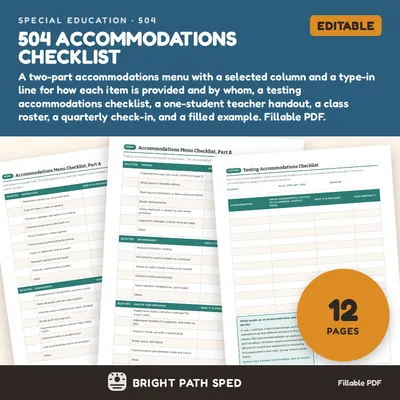
504 Accommodations Checklist Editable
$3.00 or with All-Access
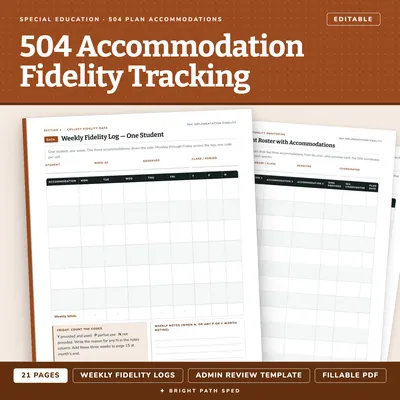
504 Plan Accommodation Implementation Fidelity Data Collection Editable
$3.50 or with All-Access
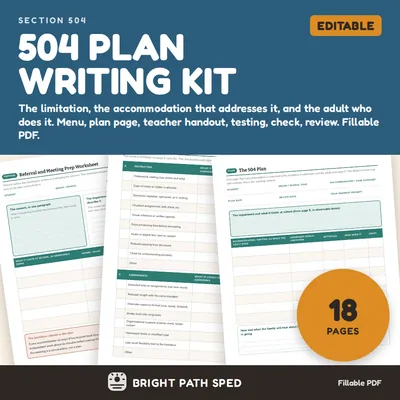
504 Plan Template Accommodations Checklist Teacher Handout
$5.00 or with All-Access
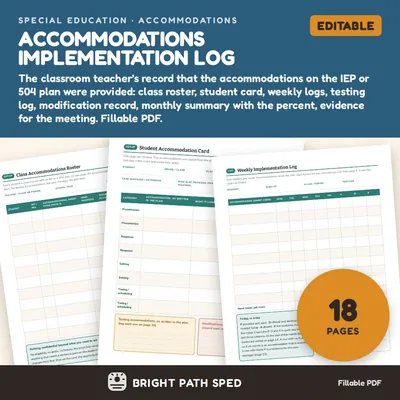
Accommodations Implementation Log Editable
$5.00 or with All-Access