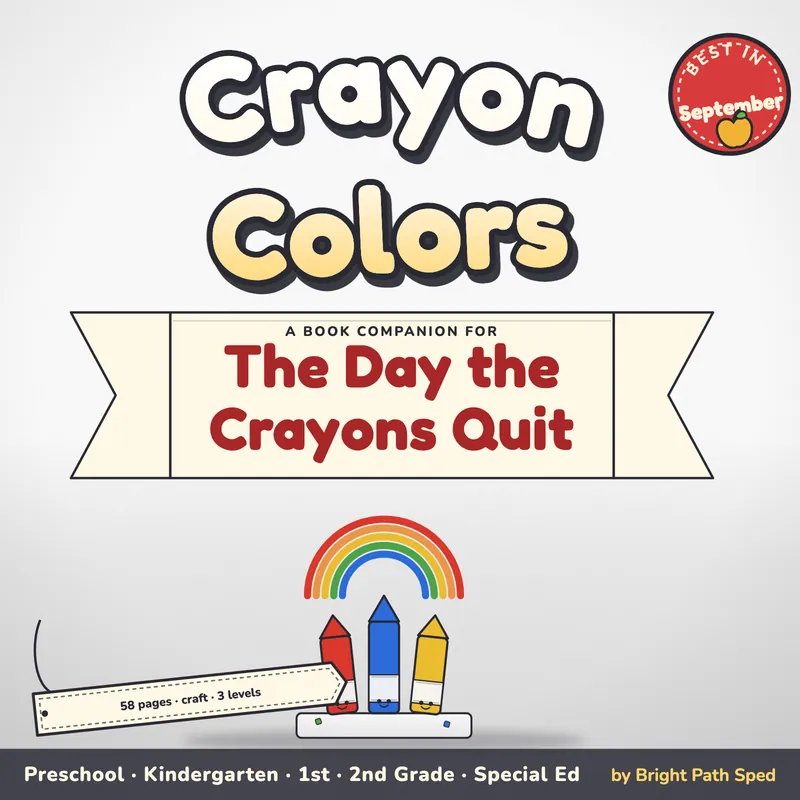
The Day the Crayons Quit Book Companion Preschool Kindergarten 1st 2nd Sped
- 58 pages
- PreK, Kindergarten, 1st, 2nd
$2.50 $5.00 on Teachers Pay Teachers
Half the Teachers Pay Teachers price. The same PDF, sold direct.
DownloadOr get it with All-Access: pick any 20 resources a month for $7.
New here? Your first month of All-Access is half off with code TEACHERTOK
Already bought this, or a member?
Instant download. One teacher's license: colleagues need their own copy. Each file carries a license number.
Also on Teachers Pay Teachers: see the Bright Path Sped store
About this resource
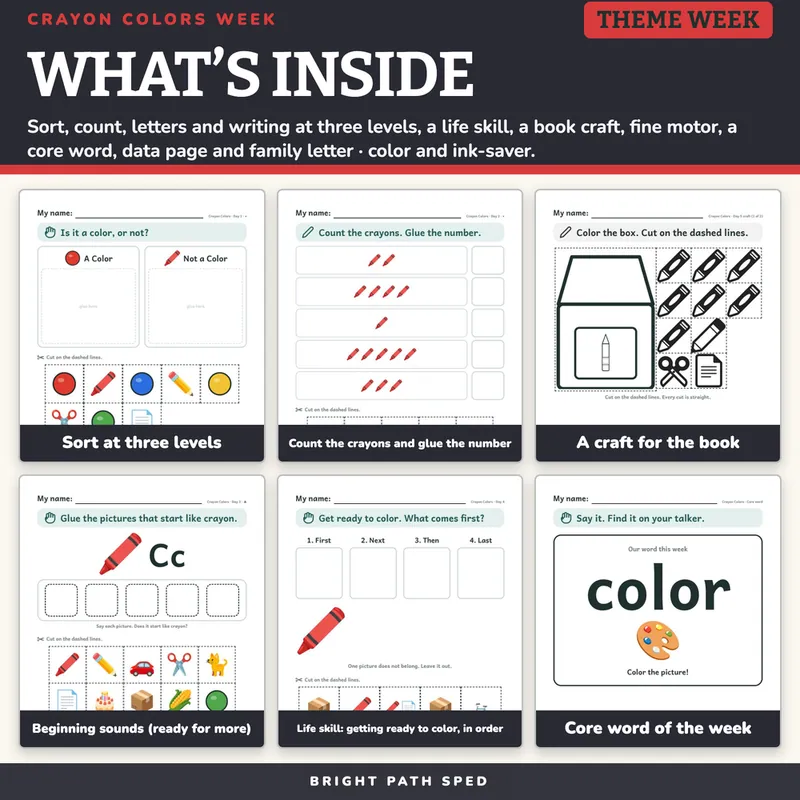
One theme, one week. Read the same book every day at circle time: a box of crayons and all the
colors you can use to color a picture. After the read-aloud each day, pull one simple activity:
sort colors from everyday classroom things, count crayons, find the letter C, put the steps of
getting ready to color in order, then build a box-of-crayons craft with seven crayons, a pencil,
scissors and a sheet of paper. Every student page has one short instruction with a picture, so a
paraprofessional can run the room from it too.
This week pairs with **The Day the Crayons Quit by Drew Daywalt** (or any gentle color-themed story
you already have). This resource is not affiliated with or endorsed by the author or publisher. You
need your own copy of the book; nothing from it is reproduced here, and every picture in the file is
our own drawing or a licensed picture set, not the book's artwork.
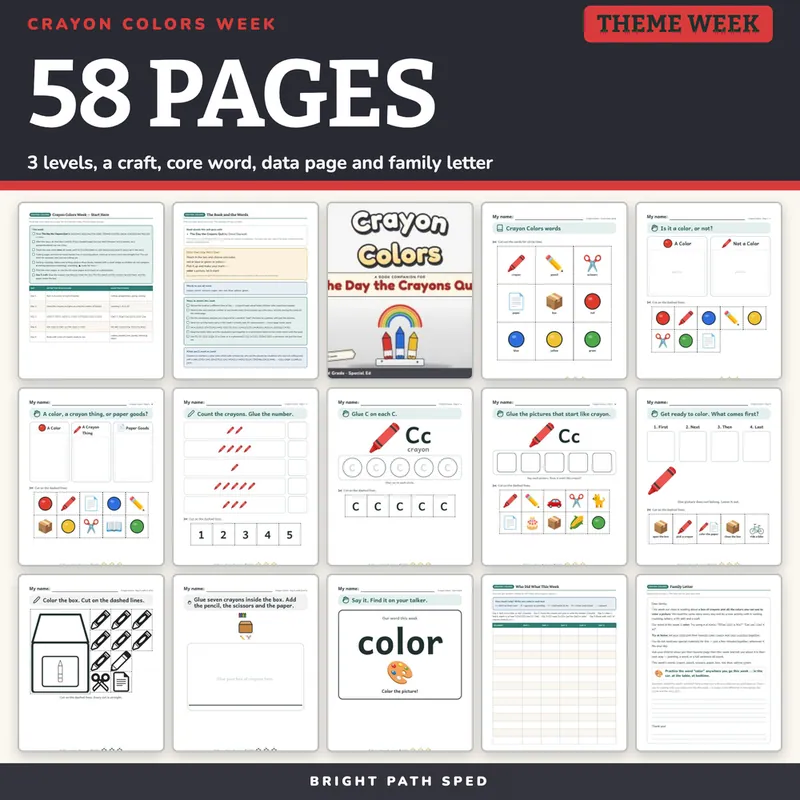
EVERYTHING INSIDE (58 pages)
- 1 Start Here week plan: what to do after the read-aloud each day, plus what else it practices
- 1 book-and-words page naming the read-aloud, an original circle-time chant ("Pick a Color,"
written for this unit — no song or story text is reprinted), and the 9 circle-time vocabulary
words
- 9 smartboard slides for whole-group circle time on a projector or interactive board: the cover
art, name the pictures, sort, count (3 slides), the letter hunt, the life skill in order, and the
core word
- 9 circle-time vocabulary cards to cut out and use at the carpet (crayon, pencil, scissors, paper,
box, red, blue, yellow, green — the four colors are our own hand-drawn circles, never an emoji
color swatch)
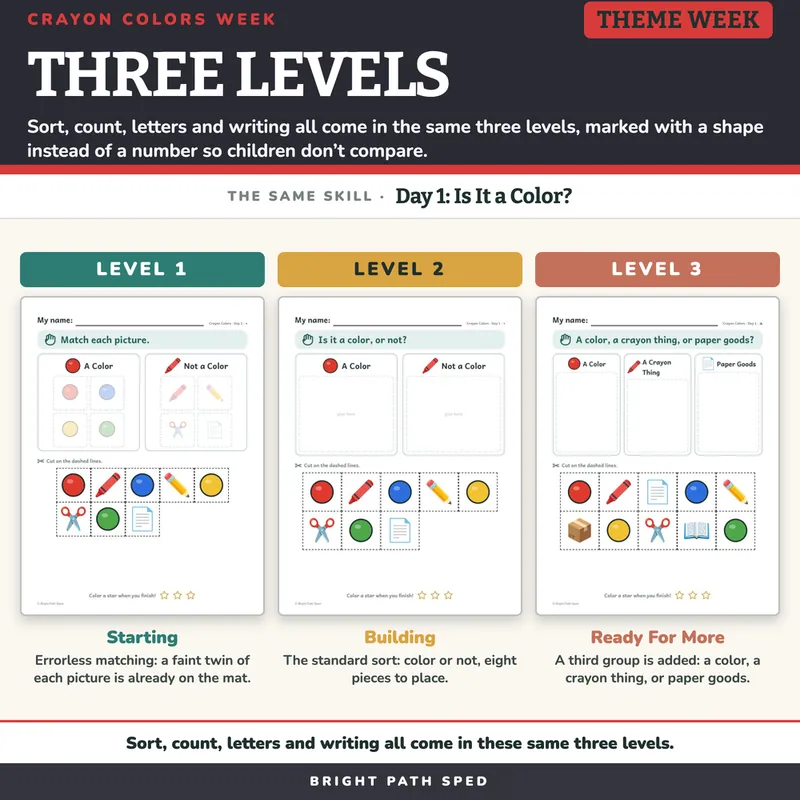
- Day 1, Sort (is it a color, or not?), at 3 levels: Level 1 errorless matching, Level 2 the
standard two-group sort (8 cut-and-glue pieces), Level 3 a third group added (a color, a crayon
thing, or paper goods — 10 cut-and-glue pieces), both levels agreeing on what counts as a color
- Day 2, Count the crayons, at 3 levels: Levels 1 and 2 count sets of 1 to 5 with a 5-piece numeral
strip to cut and glue; Level 3 counts sets of 6 to 10 and writes the number, no cutting
- Day 3, Letter C, at 3 levels: Level 1 glues 5 matching C's, Level 2 finds C among 10 look-alike
letters, Level 3 says 10 pictures aloud and glues the 5 that start like "crayon"
- Writing, at 3 levels: Level 1 traces the big letters, Level 2 traces letters and the word
"crayon," Level 3 writes the letters and the word independently on primary lines
- Day 4, a life-skill sequencing page: 5 picture pieces (4 real getting-ready-to-color steps — open
the box, pick a crayon, color the paper, close the box — first/next/then/last, plus 1 that does
not belong)
- Day 5, a book craft: color and cut an open crayon box, then a sheet of 10 pieces (seven crayons,
a pencil, a pair of scissors and a sheet of paper — every cut a straight dashed rectangle) and
glue them into a tabletop scene
- 2 fine motor pages: a tracing-paths page and a cutting-practice page (4 strips, easiest first)
- 4 core-word pages for the word of the week, "color": a big word card for the talker or core
board, a 12-word find-and-circle grid (6 of the 12 are the target word "color"), a crayon to color
(a simple standalone outline, for the simplest level of this task), and 10 color-circle pictures
to cut out and glue around it
- 1 "Who Did What This Week" data page (one row per student, a prompt-level code for each day —
handy for IEP notes and progress reports)
- 1 family letter to send home on Day 1
- 1 "More From Bright Path Sped" page: four more theme weeks that pair naturally with this one,
shown with their own real covers
- 1 credits page (art and font licenses)
- Ink-saver twins of 19 picture-based student pages (the craft and pure-coloring pages are
color-only) in outline art for a photocopier, so the color pages above are optional, not required
Three Levels On Every Academic Task
Sort, count, letters and writing each come in three levels, marked with a small shape instead of
a number so children don't compare theirs to a neighbor's: a circle for starting (errorless
matching), a square for building (the standard task), a triangle for ready for more (a real step
up — a third sort group, counting 6 to 10 with writing, or beginning sounds).
Cutting Built For Small Hands
Every cutting page carries 5 or more pieces, lined up edge to edge so each cut is one straight
line. Pre-cut them yourself for students who are not cutting independently yet.
Color Or Ink-Saver
Print the color pages, or use the ink-saver twins at the back on a photocopier — most
picture-based student pages have both (the craft and pure-coloring pages are color-only by design).
Who This Is For
Any teacher starting a self-contained preschool or early childhood special education classroom
who wants a whole week of circle time, ready to pull and go: one theme, a different simple
activity every day.
What This Is, And What It Is Not
A print-and-go weekly theme unit built around a box of crayons and the colors they make. It is not
a claim about any student's age or rate of progress, and it does not reproduce any book, its text,
or its artwork — only our own crayon, box and color-circle pieces are drawn here. The sorting
activity ("is it a color, or not?") is a simple classroom sorting task, not a scientific or clinical
claim.
You might also need
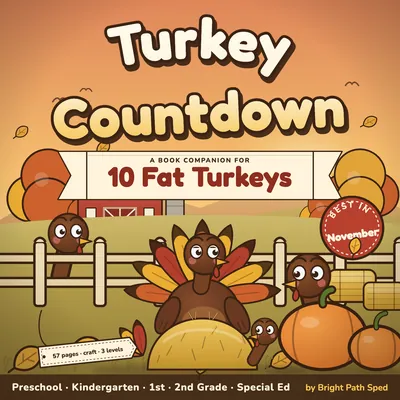
10 Fat Turkeys Book Companion November Preschool Kindergarten 1st 2nd Special Ed
$2.50 $5.00 on TPT
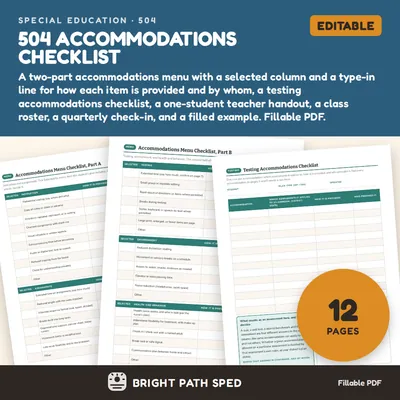
504 Accommodations Checklist Editable
$1.50 $3.00 on TPT
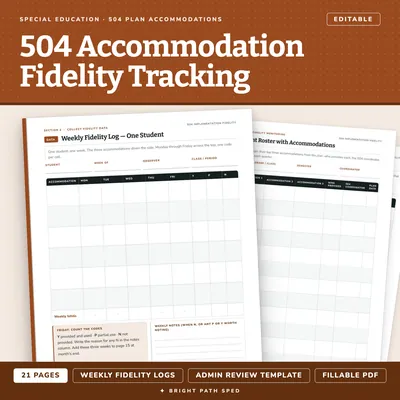
504 Plan Accommodation Implementation Fidelity Data Collection Editable
$1.75 $3.50 on TPT
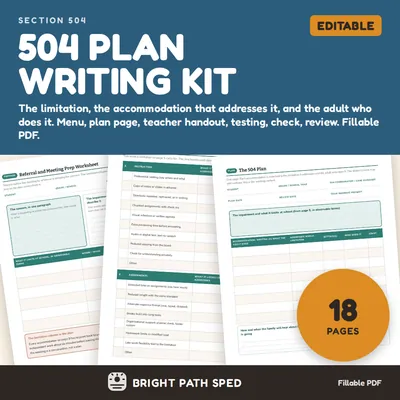
504 Plan Template Accommodations Checklist Teacher Handout
$2.50 $5.00 on TPT