Visual Schedule Template
- 34 pages
- Not Grade Specific
- PDF, fillable
$4.00 $8.00 on Teachers Pay Teachers
Half the Teachers Pay Teachers price. The same PDF, sold direct.
DownloadOr get it with All-Access: pick any 20 resources a month for $7.
New here? Your first month of All-Access is half off with code TEACHERTOK
Already bought this, or a member?
Instant download. One teacher's license: colleagues need their own copy. Each file carries a license number.
Also on Teachers Pay Teachers: see the Bright Path Sped store
About this resource
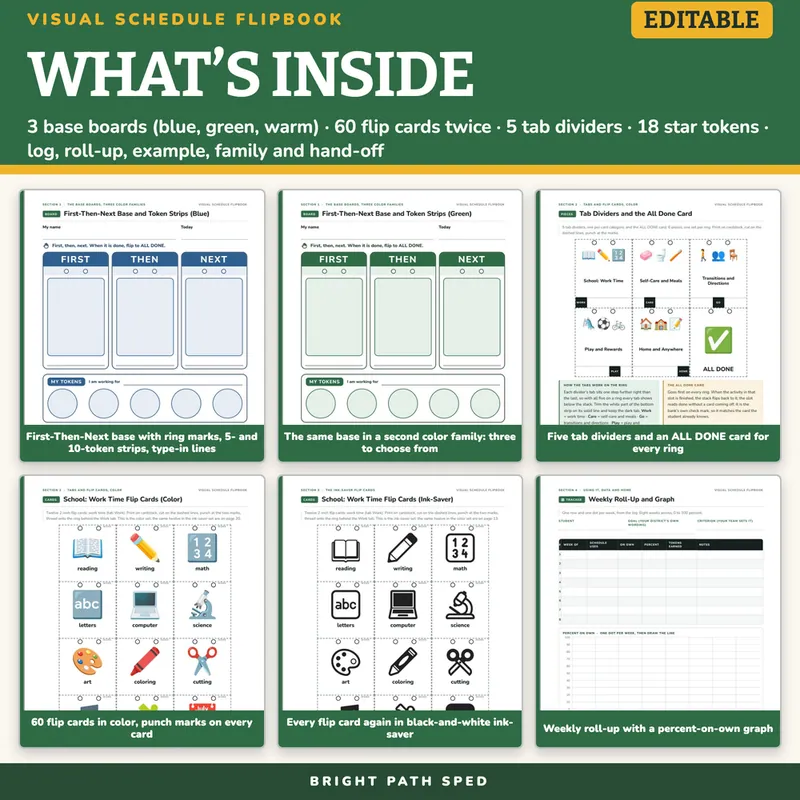
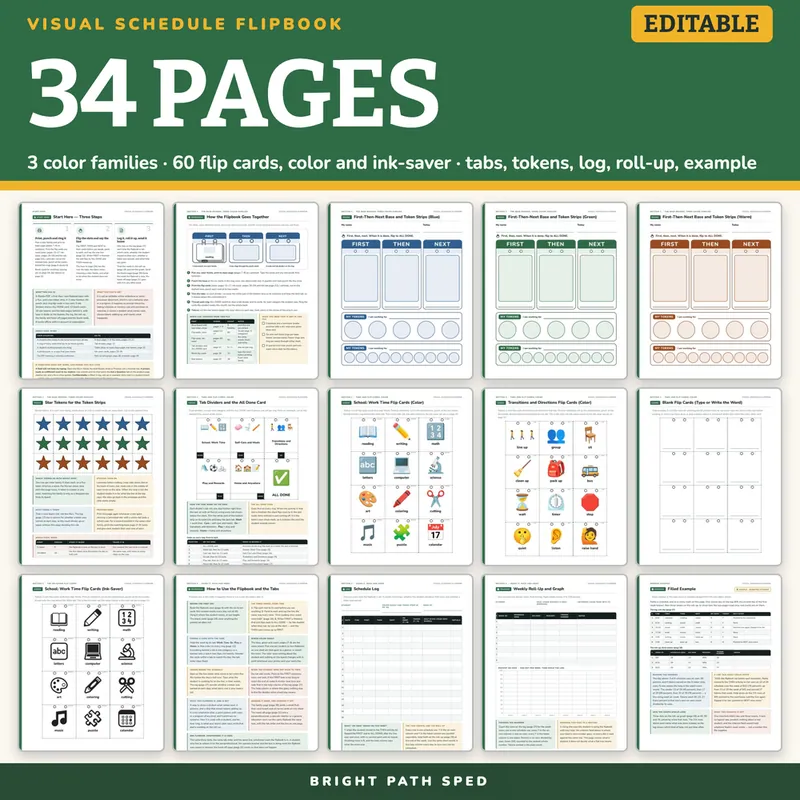
EVERYTHING INSIDE — 34 pages
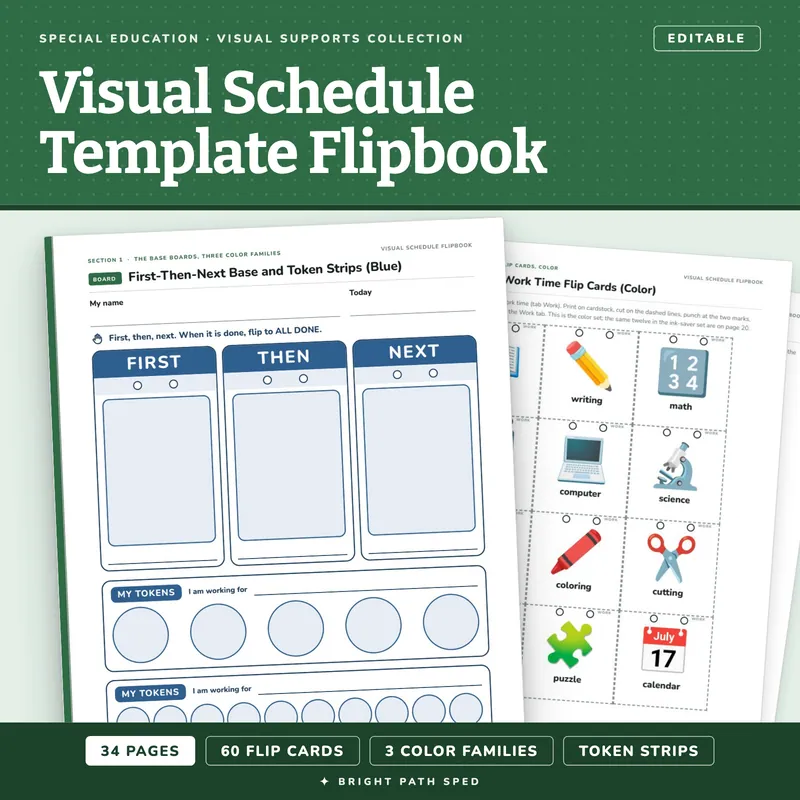
- A first-then-next flipbook base board, three times, in three color families (blue, green, warm): FIRST, THEN and NEXT panels, two punch marks above each slot for book rings, a type-in line under every slot, a "My name" and "Today" line, and a 5-token and a 10-token strip on the same page with a type-in "I am working for" line on each (7 type-in fields per base page)
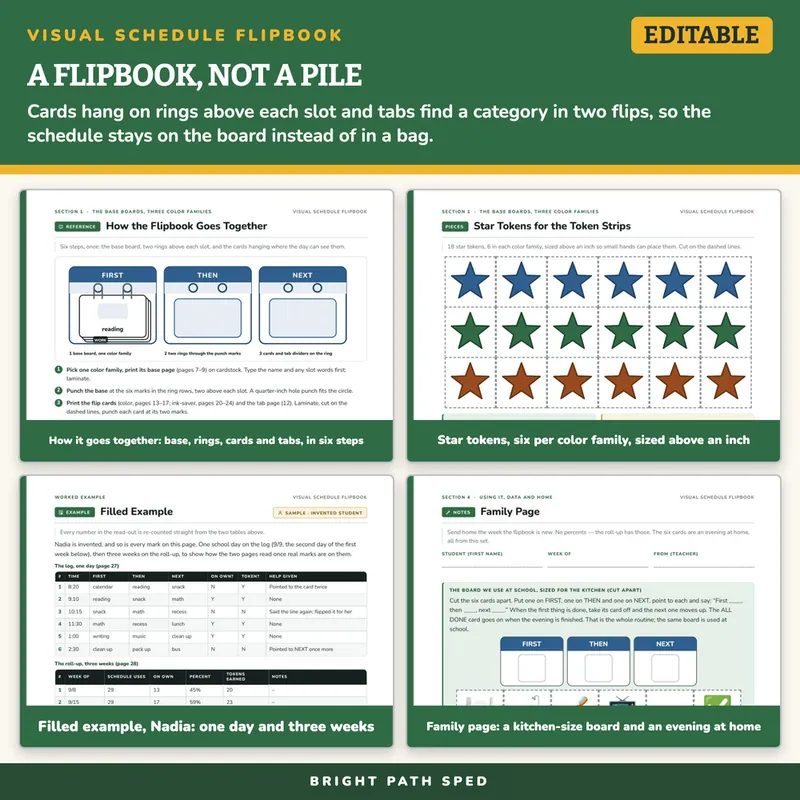
- A how-it-goes-together page: a drawn picture of the finished flipbook, six numbered steps, a parts list counted from the file, and what you need that is not in it
- 18 star tokens, 6 per color family, each above an inch square, to cut apart and velcro
- 5 tab dividers (Work, Care, Go, Play, Home — tabs staggered left to right like a binder's index) and an ALL DONE card, one set per ring
- 60 flip cards, 2 inches square, each with two punch marks along the top edge, in 5 categories of 12: School: Work Time; Self-Care and Meals; Transitions and Directions; Play and Rewards; Home and Anywhere
- Every flip card twice: a full-color set for a laminated ring and a black-and-white ink-saver set for the photocopier
- 12 blank flip cards with a type-in word line, for anything the printed set does not cover
- A how-to page: before the first day, the three moves every time, finding a card with the tabs, which color family, tokens beside the schedule, when the student does not move, what the flipbook is and is not, sending it home and handing it off
- A Schedule Log (16 rows: date, time, FIRST, THEN, NEXT, on own Y/N, token Y/N, help given, initials)
- A weekly roll-up (8 weeks) with a percent-on-own graph
- A filled example — an invented student, one school day on the log and three weeks on the roll-up, every number computed from one data table and re-counted on the page
- A family page with a kitchen-size first-then-next board and six home cards on one sheet
- A hand-off page so a paraprofessional or another classroom runs the same flipbook the same way, tab order included
- A phrase bank: 25 lines in 6 groups (spoken lines for the flipbook, written starters for the log, the roll-up and the note home)
- A storage and binder label sheet: 12 labels and a spine strip
- Start Here, a contents page with page thumbnails, and a "what's next" back page
A visual schedule that stays on the board. Most schedule sets stop at a bag of loose cards; this one is a bound flipbook: the cards hang on rings above each slot, a tab finds the category in two flips, and the slot reads ALL DONE without a card coming off. The token strips sit right under the schedule, so a token earned for a finished step stays in view of the schedule that earned it — and the log and roll-up behind it turn a week of flips into a line on a page a case manager can bring to a meeting.
The Flipbook
Three panels — FIRST, THEN, NEXT — each with two punch marks above its slot. Two one-inch book rings go through the marks; the flip cards (punched the same way) hang on the rings and the front card lies over the slot. Flip to the next card and the schedule changes. Five tab dividers sit between the categories on every ring, each tab one step further right than the last, so a 60-card ring is found by category, not by thumbing through it. The ALL DONE card goes first on every ring: when the slot's activity is finished, the stack flips back to it.
Three Color Families, Every Label Editable
The base page prints three times — blue, green and warm — and the three are the same board. Pick one per student so two flipbooks on one shelf are told apart at a glance, or match the room; the color says nothing about the student. Type the name, the slot words and what the student is working for before you print, or print and write by hand.
The Flip Cards (60)
Work: reading, writing, math, letters, computer, science, art, coloring, cutting, music, puzzle, calendar. Care: wash hands, bathroom, brush teeth, get dressed, shoes, coat, bath, breakfast, snack, lunch, dinner, drink. Go: line up, group, sit, clean up, pack up, bus, wait, timer, stop, quiet, listen, raise hand. Play: recess, ball, bike, video game, teddy bear, bubbles, dinosaur, headphones, swim, run, prize, cookie. Home: home, school, homework, tv, bedtime, trash, store, car, dog, outside, break, all done. Every picture was chosen to be named in one word by a young child, in color AND in the black-and-white set; a word that failed in either set was left out of both.
What This Is, And What It Is Not
It is a fillable PDF: type into the base boards' name and slot lines, the token strips, the log, the roll-up, the family page, the hand-off page and the blank cards, or print and use a pen. The card, tab and token pages print on cardstock and cut along dashed lines. It works offline with no account or subscription. It is NOT an editable online slideshow or word-processor document.
It is a way to show a student what comes next, in pictures, and a strip that shows tokens adding up. It is not a behavior plan, a point system with rules, or a program of any kind, and it promises no outcome. It carries no prompt hierarchy, fading schedule or mastery rule; what earns a token, what the reward is, and how long the flipbook is used are what your team's plan says. The goal line and the criterion field are blanks for your district's own wording and your team's own number.
Who This Is For
Special education teachers and paraprofessionals who run a visual schedule and a token system for the same student, case managers who need that use to show up as data, and the families who get the home page sent home.
More In The Collection
Part of the Visual Supports Collection, alongside First-Then Board and Activity Picture Cards (the same 60 cards as flat velcro cards, with three first-then boards), Visual Schedule Cards Editable (drawn icons with a type-in label on every card) and Choice Boards for Special Education; more picture-card sets are being added to the collection regularly, all on the same cards-plus-data shape.
Pictures (color pages): Noto Emoji by Google, Apache License 2.0. Pictures (ink-saver pages): Fluent Emoji, Copyright (c) Microsoft Corporation, MIT License.