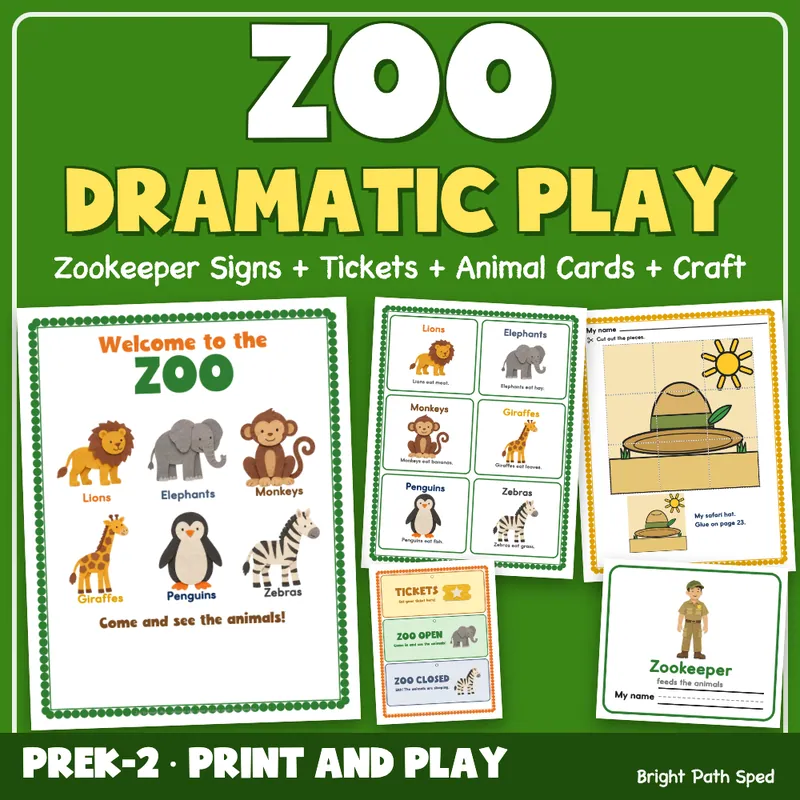
Zoo Dramatic Play
- 25 pages
- PreK, Kindergarten, 1st, 2nd
$2.50 $5.00 on Teachers Pay Teachers
Half the Teachers Pay Teachers price. The same PDF, sold direct.
DownloadOr get it with All-Access: pick any 20 resources a month for $7.
New here? Your first month of All-Access is half off with code TEACHERTOK
Already bought this, or a member?
Instant download. One teacher's license: colleagues need their own copy. Each file carries a license number.
Also on Teachers Pay Teachers: see the Bright Path Sped store
About this resource
A zoo dramatic play center you print, trim and play: a welcome-to-the-zoo sign, a ticket booth sign, a ZOO OPEN sign and a ZOO CLOSED sign, 6 exhibit signs (lions, elephants, monkeys, giraffes, penguins, zebras), 8 zoo tickets, 6 feed-the-animals food cards, 6 animal cards, 4 how-to-play step cards and 6 role badges (zookeeper, ticket seller, visitor), plus the pages children work on: zoo report sheets on three levels, a zookeeper daily checklist, an animal spotting sheet, animal clues to cut and glue on three levels, a count-the-animals page and a 9-piece cut-and-glue safari hat craft. 25 pages, PreK-2.
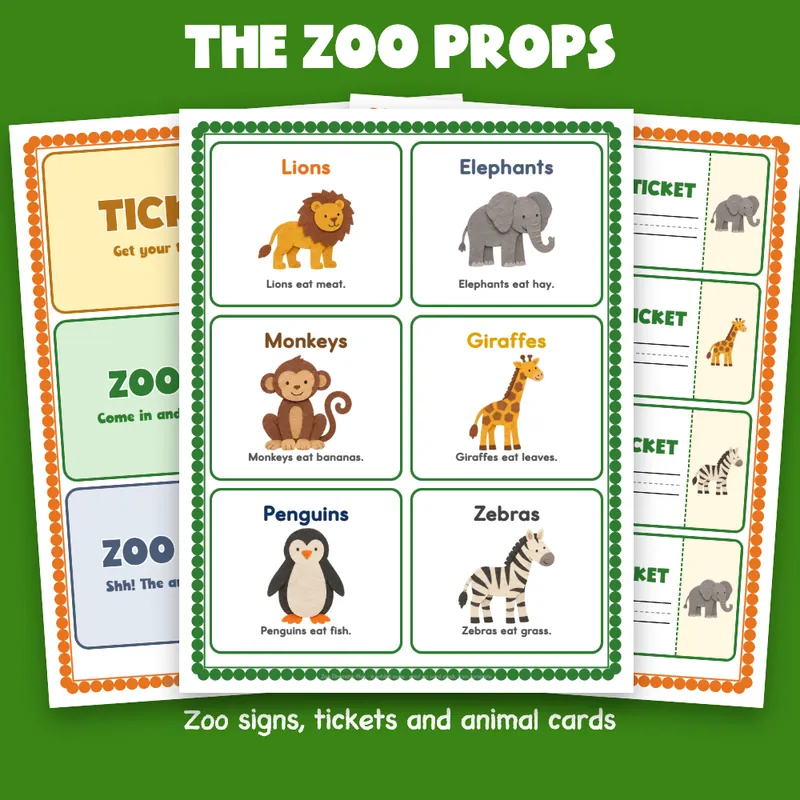
The Zoo Props
Print the prop pages on card stock, trim and laminate them once, and the zoo is ready all year. The welcome sign goes at the entrance. The ticket booth sign, the ZOO OPEN sign and the ZOO CLOSED sign stand at the ticket table. Each of the 6 exhibit signs has a big animal picture, the animal's name and one plain sentence ("Lions eat meat."). The 8 zoo tickets say Admit one and have a line for the visitor's name; no prices are printed anywhere. The 6 food cards (meat, hay, bananas, leaves, fish, grass) are for the zookeeper to feed the animals. The 6 animal cards give each animal's name and one thing it does ("I roar.", "I climb.", "I swim."). The 4 step cards tell children how to play: get a ticket, look at the animals, feed the animals, tell what you saw. The 6 role badges (2 each of Zookeeper, Ticket Seller and Visitor) have a line for the child's name.
The Pages Children Work On
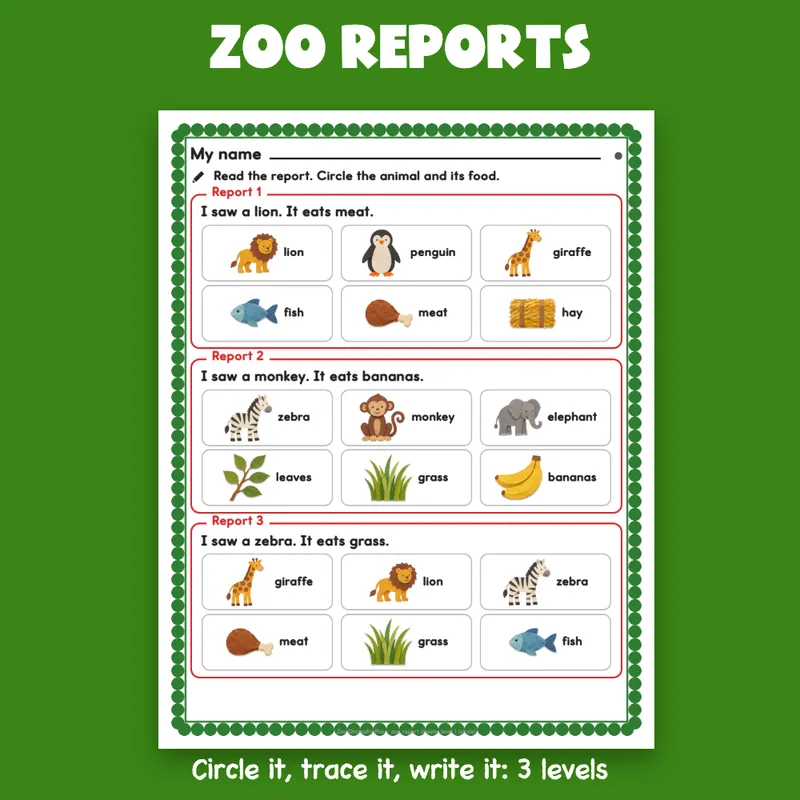
- Zoo report sheets on three levels. Level 1, circle: read the report ("I saw a lion. It eats meat.") and circle the animal and its food (3 reports). Level 2, trace: look at the animal and its food and trace the words (4 reports). Level 3, write: look at the pictures and write the report with a word bank (4 reports; report 1 is written in as the example).
- A zookeeper daily checklist: 6 jobs to check off, from opening the gate to waving goodbye, with a line to write about the zoo day.
- An animal spotting sheet: 6 animals with 5 circles each to color every time you spot one.
- Animal clues, three levels: cut 6 food pictures and glue each one by the animal that eats it. Level 1 has a faint twin to match, level 2 has no twin, and level 3 adds a line to write the food word.
- Count the animals: 6 rows of animals to count and a box to write each number (the first row is done as the example).
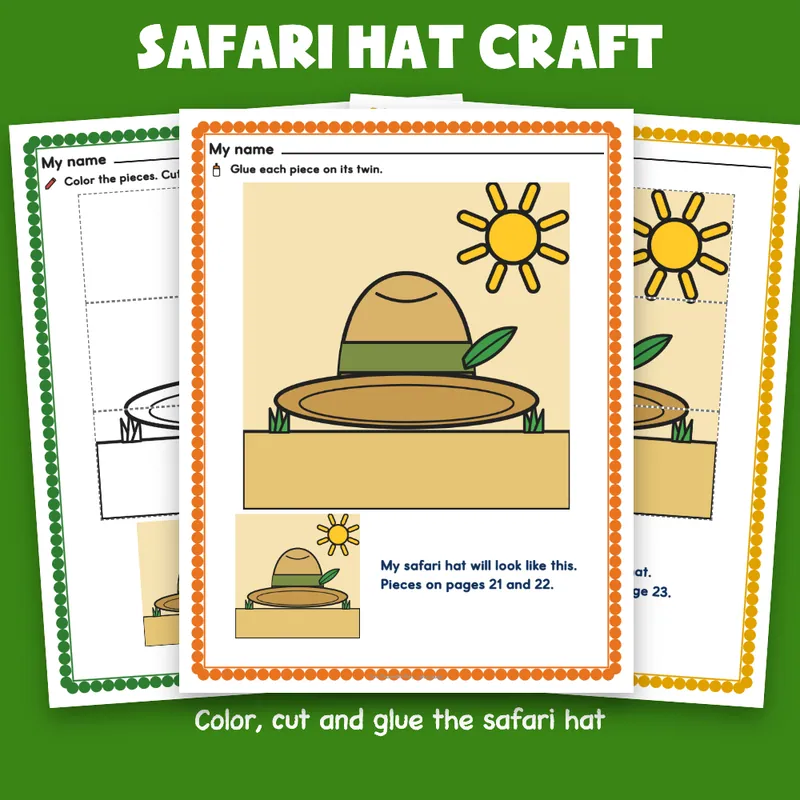
- Assemble a safari hat craft: one big safari hat with a band and a feather, on sand with a sun and two grass tufts, cut into 9 equal squares in three columns and three rows. Color the black-and-white pieces (or use the ready-colored set), cut them out and glue each piece on its faint twin. Every glue box is exactly the size of its piece.
- A word bank of 6 animal words to trace and write.
What'S Inside
- Start Here and set-up tips: how to build the zoo, the jobs, how the play goes, the three levels and a five-day plan
- Welcome sign; ticket booth, ZOO OPEN and ZOO CLOSED signs
- 6 exhibit signs
- 8 zoo tickets
- 6 feed-the-animals food cards
- 6 animal cards
- 4 how-to-play step cards
- 6 role badges
- A word bank page: 6 words to trace and write
- Zoo report sheets: circle, trace and write levels (one sheet per level)
- A zookeeper daily checklist and an animal spotting sheet
- Animal clues cut and glue: 3 levels, 6 pieces on each
- A count-the-animals page
- Assemble-a-safari-hat craft: 9 pieces to color and cut, the same 9 ready-colored, and a glue page
- A "Who Did What This Week" class data page, with the answers
- A credits page (fonts and pictures) with what is next
25 pages in all, 21 of them for the zoo and the children (pages 3 to 23).
Cutting Built For Small Hands
On the pages a child cuts, every piece sits edge to edge with the next so each cut is one straight line: 2.4 by 1.5 inch food pictures on levels 1 and 2, 2.4 by 1.3 inch pictures on level 3, and 2.1 inch hat pieces. A child cuts 36 pieces in all (18 food pictures, 9 black-and-white hat pieces and 9 ready-colored hat pieces). The prop pages (signs, tickets, food cards, animal cards, step cards and badges) are meant for the teacher to trim and laminate. You will need crayons, scissors and glue sticks. Card stock suits the props and the craft best.
Three Skill Levels
A small shape beside the name line marks the report sheets and the animal clues: circle, square and triangle. Easier: circle the report, or match the faint twin, or a partner who holds the glue stick. Harder: write the report, glue the food and write the word.
Who This Is For
Preschool, PreK, kindergarten and 1st to 2nd grade classrooms, self-contained special education classrooms, and paraprofessionals who want a pretend-play center with oral language, animal words, early reading, counting and writing attached, ready to print.
What This Is, And What It Is Not
A printable PDF (print, trim and play). It is not Google Slides, Docs or PowerPoint, and it has no fillable fields. It is a pretend zoo with six familiar animals and one plain sentence about each, and it is not an animal science unit. It is not a book companion and uses no book's characters or pictures. It makes no claim about any student's age or rate of progress.