Semantic Word Relationships Progress Monitoring Editable
- 22 pages
- Not Grade Specific
- PDF, fillable
$3.50
DownloadOr get it with All-Access: pick any 20 resources a month for $7.
New here? Your first month of All-Access is half off with code TEACHERTOK
Already bought this, or a member?
Instant download. One teacher's license: colleagues need their own copy. Each file carries a license number.
Also on Teachers Pay Teachers: see the Bright Path Sped store
About this resource
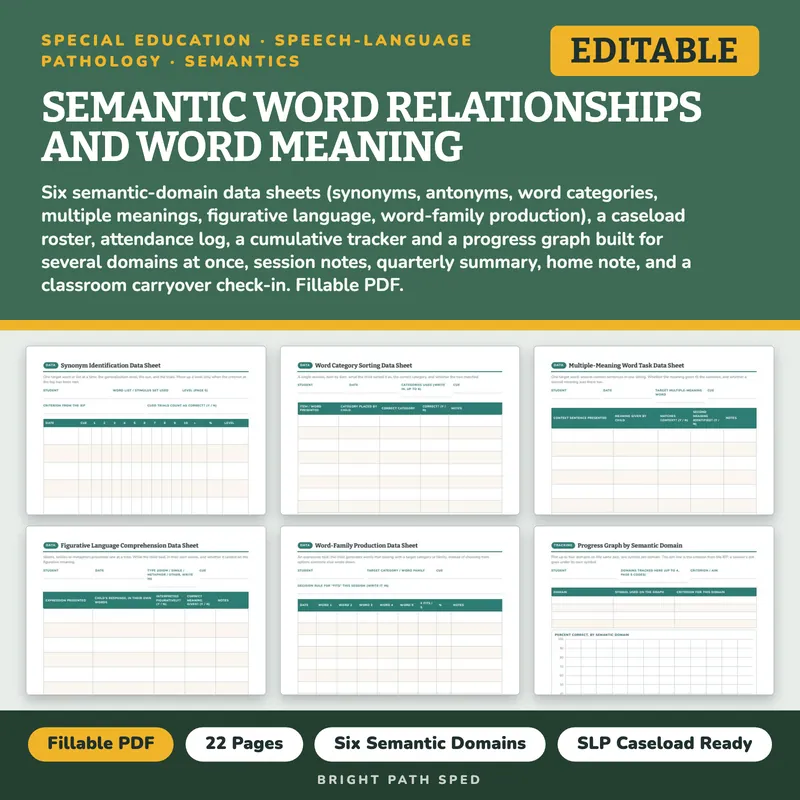
The store's speech data sheets track one sound or one process. This file tracks SEMANTICS: how a student relates and uses word meaning, apart from articulation and apart from a general vocabulary-size count. Six data sheets carry the caseload through six domains that show up in real goal wording — synonyms, antonyms, word categories, multiple-meaning words, figurative language, and word-family production, an expressive task with its own scoring rule because generating a word has no fixed answer key the way choosing one does. A progress graph built for tracking several domains on one axis, with a symbol legend so the dots do not get mixed up, sits alongside the store's usual roster, schedule, attendance log, cumulative tracker, session notes, quarterly summary, home note and classroom carryover check-in.
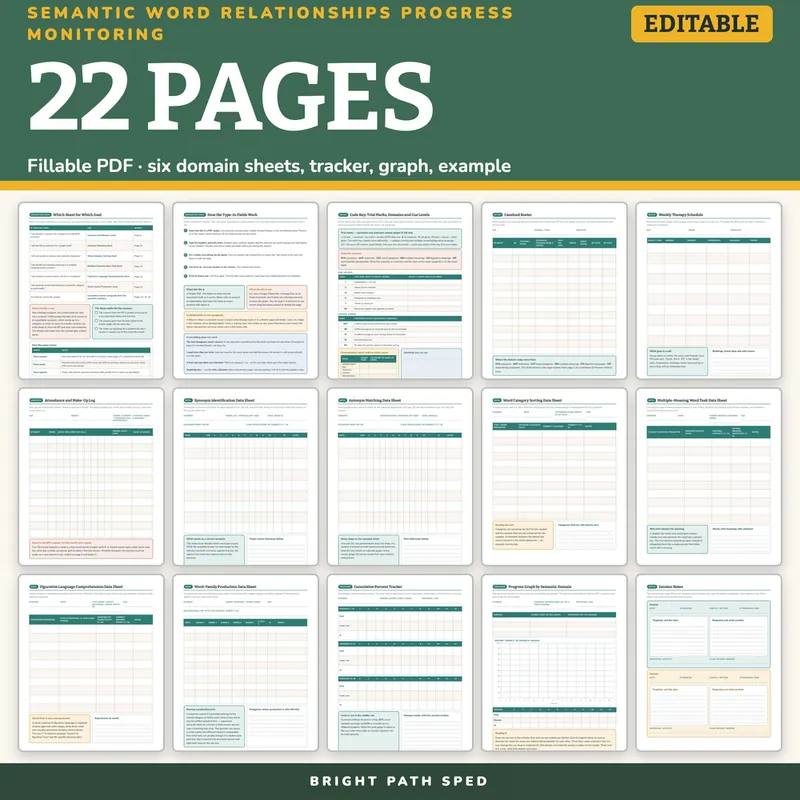
WHAT IS INCLUDED — 22 pages, 1,316 type-in fields
Setup
- Which Sheet for Which Goal — a chooser table matching seven common goal phrasings to the sheet that answers them, plus a "How the Paper Moves" table covering the session, week and quarter workflow
- How the Type-In Fields Work — one page, so nobody emails you
- Code Key — trial marks (+, −, cue codes, 0, X), the six semantic-domain codes (SYN, ANT, CAT, MM, FIG, WF), six cue levels (I, V, M, P, T, Mx), a write-in generalization-level table (isolated word pair through spontaneous conversation), and five progress-status codes
- Caseload Roster — 15 students: teacher/room, the domain(s) tracked from the code key, minutes per week per the IEP, group, sheet page, IEP and re-evaluation dates
Attendance And Data
- Weekly Therapy Schedule — 10 time blocks across five days, push-in or pull-out
- Attendance and Make-Up Log — 13 rows, 8 date-seen cells each, missed date/code and made-up date
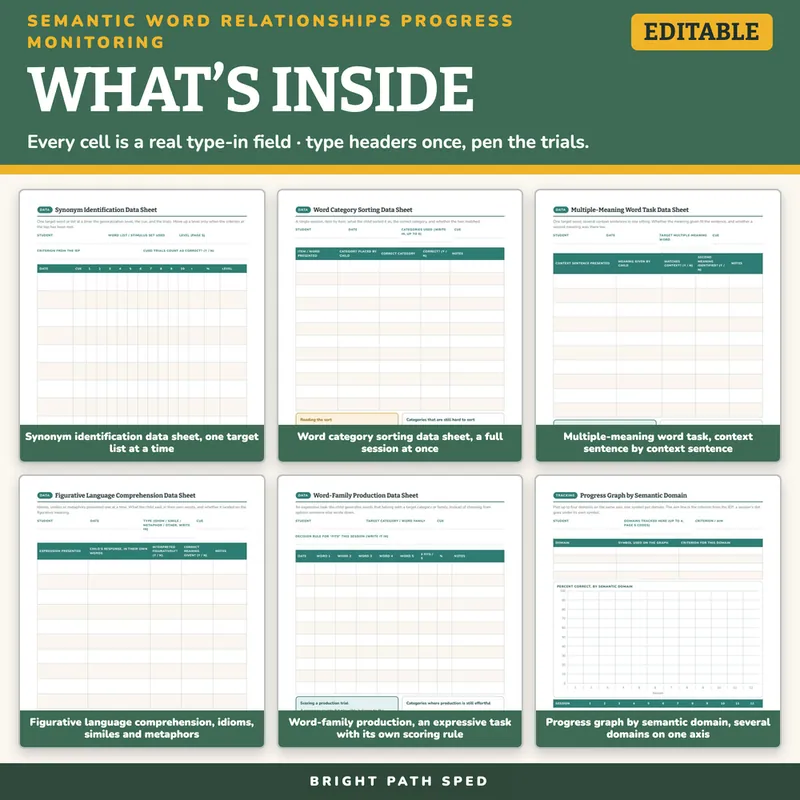
- Synonym Identification Data Sheet — 9 dated rows of 10 trial cells each, with a cue column, a correct count, a percent column and a generalization-level column
- Antonym Matching Data Sheet — same shape, for the opposite relationship
- Word Category Sorting Data Sheet — 12 rows for one session: item presented, the category the child placed it in, the correct category, and a correct/not column
- Multiple-Meaning Word Task Data Sheet — 10 rows for one session: context sentence, meaning given, whether it matched context, and whether a second meaning was identified
- Figurative Language Comprehension Data Sheet — 10 rows for one session: the expression presented, the child's response in their own words, whether it was read figuratively, and whether the specific meaning was correct
- Word-Family Production Data Sheet — 11 dated rows with five word slots each, a fits-count out of 5, a percent column, and a write-in decision rule for what counts as "fits" that session
Tracking, Reporting And Home
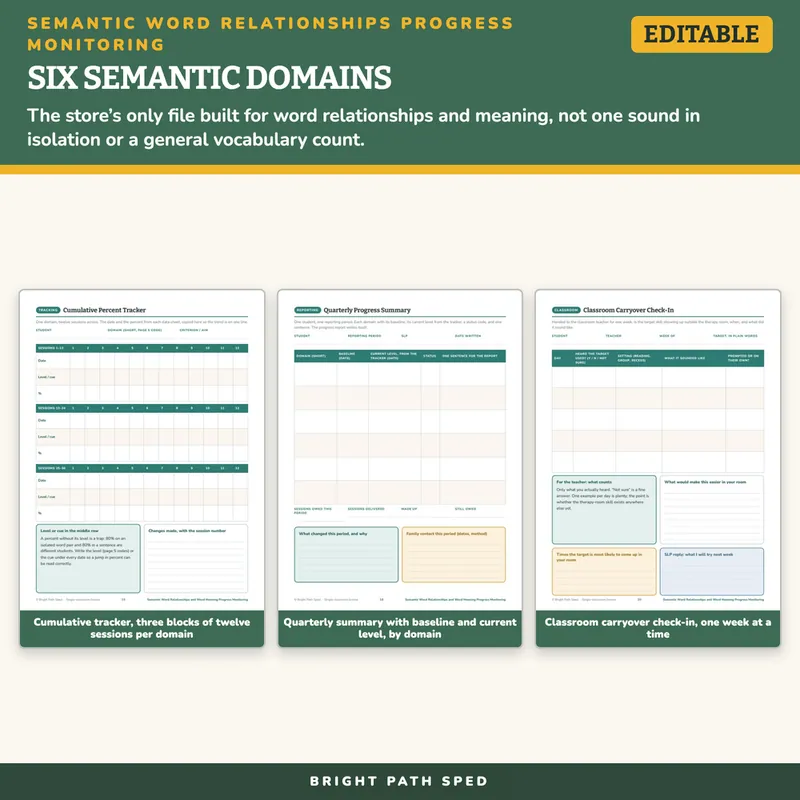
- Cumulative Percent Tracker — one domain, 36 sessions across three 12-session blocks, with a level/cue row under every date
- Progress Graph by Semantic Domain — a four-row symbol legend plus one grid, so up to four domains can be plotted on the same axis and told apart
- Session Notes — two sessions per page, data in every one
- Quarterly Progress Summary — 6 domain rows: baseline, current level from the tracker, status code, one sentence, plus sessions owed/delivered/made up/still owed
- Semantic Language Home Note — what we worked on, something that went well, one practice idea, a 7-day practice tracker
- Classroom Carryover Check-In — a 5-day table for the classroom teacher: heard the target used, where, what it sounded like, prompted or not
- Filled-in example for an invented second grader (Ava) showing a synonym data sheet moving from 80% to 100% at the word level, a six-domain snapshot table with three different status codes side by side, a quarterly summary row and a session note, all cross-checked
What This Is, And What It Is Not
It is a fillable PDF. Open it in a PDF reader, click a field, type, press Tab to move on, Save As once per student. It works offline with no account or subscription. It is NOT a Google Sheets file, a Google Doc or a PowerPoint presentation.
It is not a therapy program, not a word list, not a screener, and not an assessment battery. Which words, sentences or pictures to use, what counts as an acceptable synonym or category, and when to move to a harder context are the SLP's own clinical judgment, written in; this file never decides them on its own. No age, eligibility or IDEA-timeline claim anywhere; no health data is pre-filled, and the example student (Ava) is invented and named as such on page 21.
Who This Is For
School-based SLPs, SLPAs and reading specialists tracking word relationships and word meaning — synonyms, antonyms, categories, multiple meanings, figurative language, word-family production — as goals distinct from articulation, phonological processes or a general vocabulary-size count.
If You Want More
Speech Therapy Data Collection Sheets Editable is the 22-page general caseload version of this file: six data sheets, tracker, graph, home note. IEP Goal Tracking Editable is the 24-page classroom-teacher side of the same goals: tracker, graph, decision rules, report writer.
You might also need
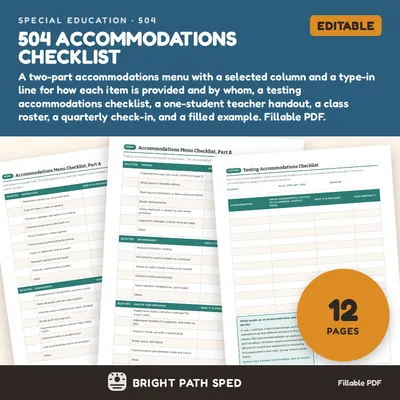
504 Accommodations Checklist Editable
$3.00 or with All-Access
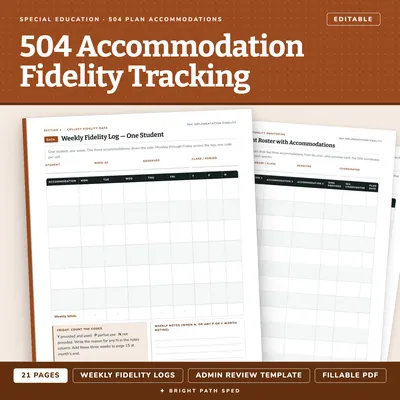
504 Plan Accommodation Implementation Fidelity Data Collection Editable
$3.50 or with All-Access
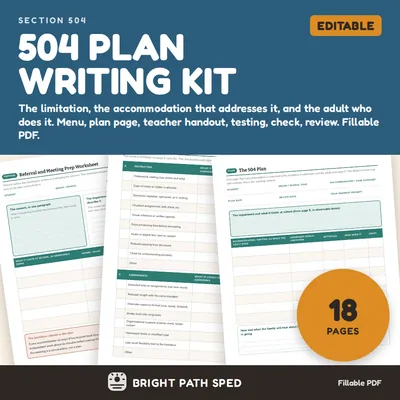
504 Plan Template Accommodations Checklist Teacher Handout
$5.00 or with All-Access
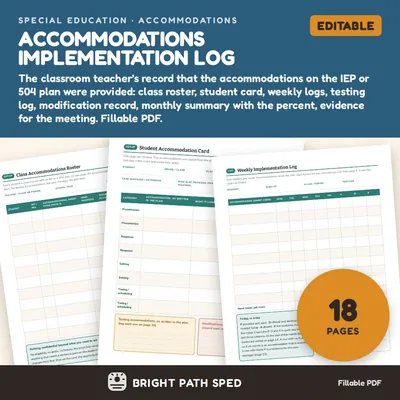
Accommodations Implementation Log Editable
$5.00 or with All-Access